
 By Claire Whitaker
Updated November 2026
Shopping for a pro chef knife sharpener can feel harder than it should. Electric models, manual two-stage units, and hybrid machines all promise a sharp edge, but they work in different ways and suit different knives and habits. This guide looks at seven sharpeners from Chef’sChoice and a few other makers, comparing them on the factors that matter most: abrasive type, angle control, the number of stages, ease of use, and how well each handles straight-edge and serrated blades. Nothing here comes from personal testing. The picks are based on published specifications, brand track record, and patterns that owners commonly describe in their feedback.
Our top picks at a glance
- 1
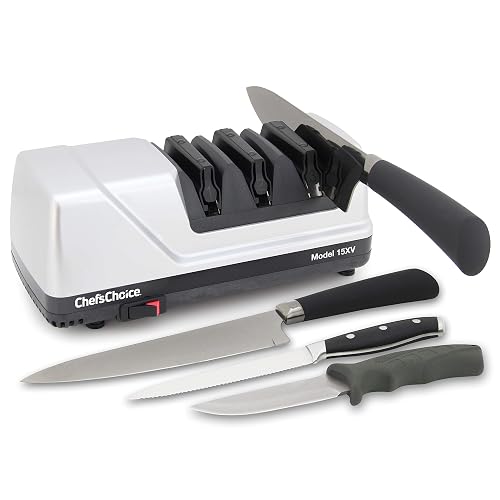 TOP CHOICEBest overallChef'sChoice 15XV EdgeSelect Professional Electric Knife SharpenerView on Amazon
- 2
 TOP CHOICEBest for home cooks who want a manual optionChef'sChoice Manual Knife Sharpeners 2-StageView on Amazon
- 3
 TOP CHOICEBest for small kitchensChef Pro Electric Kitchen Knife Sharpener and Polishing SystemView on Amazon
- 4
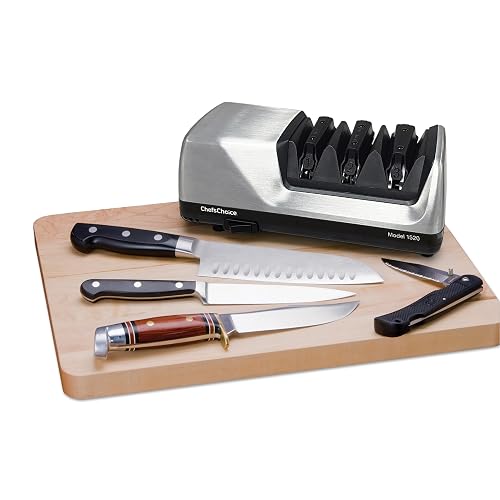 Best for regular sharpening with two anglesChef'sChoice Professional Electric Knife Sharpener AngleSelectView on Amazon
- 5
 Best for a 3-stage electric workflowChef'sChoice Professional Electric Knife Sharpener 3-StageView on Amazon
- 6
 Best for hand-controlled sharpeningRolling Knife Sharpening Kit (Tumbler Pro Rolling Knife Sharpener)View on Amazon
- 7
 Best hybrid optionChef'sChoice Hybrid Knife Sharpener 3-StageView on Amazon
Our Top Picks
Quick Comparison
| Product | Best for | Key feature |
|---|---|---|
| Chef’sChoice 15XV EdgeSelect Professional Electric Knife Sharpener | Overall use on straight and serrated knives | 3 stages with diamond abrasives and angle guides |
| Chef’sChoice Manual Knife Sharpeners 2-Stage | Home cooks who prefer manual control | Diamond abrasives with 15 and 20 degree guides |
| Chef Pro Electric Kitchen Knife Sharpener and Polishing System | Small kitchens | Suction cup base and compact design |
| Chef’sChoice Professional Electric Knife Sharpener AngleSelect | Switching between 15 and 20 degree edges | 2 stages with precision angle control |
| Chef’sChoice Professional Electric Knife Sharpener 3-Stage | Full sharpen, hone, and polish routine | 3 stages with diamond abrasives |
| Rolling Knife Sharpening Kit (Tumbler Pro) | Hand-guided control at a set angle | Removable discs with diamond and ceramic layers |
| Chef’sChoice Hybrid Knife Sharpener 3-Stage | Users who want electric and manual options | Combines electric and manual sharpening |
Chef’sChoice 15XV EdgeSelect Professional Electric Knife Sharpener
Chef’sChoice 15XV EdgeSelect Professional Electric Knife Sharpener with 100-Percent Diamond Abrasives and Precision Angle Guides for Straight Edge and Serrated Knives, 3-Stage, Gray
Best for: Overall use on both straight-edge and serrated knives
This is a good fit for home cooks with a mixed set of knives who want a single machine that handles most of the work. It is designed for people who would rather let the guides set the angle than hold it by hand.
Key specs
- 3-stage sharpening
- 100-percent diamond abrasives
- Precision angle guides for straight-edge and serrated knives
Pros
- Handles both straight-edge and serrated blades
- Separate stages for sharpening, honing, and polishing
- Angle guides reduce guesswork for beginners
Cons
- Takes up more counter space than manual tools
- Electric operation can remove more metal than a careful hand stone if used too often
Bottom line: A strong first choice for someone who wants an all-in-one electric sharpener and plans to use it regularly on a range of knives.
Chef’sChoice Manual Knife Sharpeners 2-Stage
Chef'sChoice Manual Knife Sharpeners for 15- and 20-Degree Straight-Edge and Serrated Knives with Diamond Abrasives Precise Angle Control & Compact Footprint, 2-Stage, Gray
Best for: Home cooks who prefer manual control and a compact footprint
This suits people who want a small, low-power tool and are comfortable drawing the knife through slots by hand. It is also useful for occasional touch-ups between full sharpening sessions.
Key specs
- 2-stage manual sharpening
- Diamond abrasives
- 15 and 20 degree angle guides for straight-edge and serrated knives
Pros
- Compact and easy to store
- No electrical outlet required
- Angle guides help keep the edge consistent
Cons
- Requires a steady, even pull to get the best result
- Slower than electric models for a full sharpen
Bottom line: Best for cooks who want a simple tool and don’t mind a few extra minutes of manual work.
Chef Pro Electric Kitchen Knife Sharpener and Polishing System
ELECTRIC KITCHEN KNIFE SHARPENER AND POLISHING SYSTEM by CHEF PRO, 2-Stage Sharpening, Compact And Easy-to-Use Design, Suction Cup Bottom and Easy Cleaning, Black-Silver
Best for: Small kitchens where counter space is limited
This is aimed at apartment cooks and anyone who wants a sharpener that can sit on the counter without taking over. The suction cup base keeps it from sliding during use.
Key specs
- 2-stage sharpening and polishing
- Compact electric design
- Suction cup bottom for stability
Pros
- Small footprint
- Suction cup base reduces movement
- Simple two-stage routine
Cons
- Fewer stages than the 3-stage Chef’sChoice models
- Owners may find the suction base less reliable on rough surfaces
Bottom line: A practical choice for small kitchens that need a basic electric sharpener without a large footprint.
Chef’sChoice Professional Electric Knife Sharpener AngleSelect
Chef'sChoice Professional Electric Knife Sharpeners AngleSelect for 15- and 20-Degree Straight-Edge and Serrated Knives with Diamond Abrasives & Precision Angle Control, 2-Stage, Metallic
Best for: Switching between 15 and 20 degree edges
This model suits cooks who own Western-style knives and Asian-style blades that call for different edge angles. The angle selection makes it easy to match the sharpener to each knife.
Key specs
- 2-stage electric sharpening
- Diamond abrasives
- 15 and 20 degree angle selection
Pros
- Lets you choose between 15 and 20 degree edges
- Diamond abrasives cut quickly and hold their shape
- Works on straight-edge and serrated knives
Cons
- Two stages means less polishing than a 3-stage unit
- Requires care to keep the slots clean
Bottom line: Good for mixed knife collections where edge angle matters.
Chef’sChoice Professional Electric Knife Sharpener 3-Stage
Chef’s Choice Professional Electric Knife Sharpeners for 15- and 20-Degree Straight-Edge and Serrated Knives with Diamond Abrasives & Precision Angle Control, 3-Stage, White
Best for: A full sharpen, hone, and polish routine on a regular basis
This is for cooks who want the complete process in one machine. The third stage is useful for finishing the edge after sharpening.
Key specs
- 3-stage electric sharpening
- Diamond abrasives
- 15 and 20 degree angle guides
Pros
- Three stages cover sharpening through polishing
- Angle guides support consistent results
- Works on straight-edge and serrated blades
Cons
- Larger than two-stage models
- Higher stage count means more steps to learn
Bottom line: A solid pick for cooks who want a thorough electric routine and have the counter space for it.
Rolling Knife Sharpening Kit (Tumbler Pro Rolling Knife Sharpener)
Rolling Knife Sharpening Kit, Removable Discs, 4-Layer Diamond & EdgeBoost Ceramic Disc (Black) Tumbler Pro Rolling Knife Sharpener™ (Black)
Best for: Hand-guided control at a set angle
This suits people who want to feel the stone work across the blade and who prefer a rolling motion to a slot-based tool. It is a manual option that uses removable discs.
Key specs
- Removable discs
- 4-layer diamond disc and ceramic disc included
- Manual rolling operation
Pros
- Manual control over the sharpening motion
- Different discs for different stages of the edge
- No electrical outlet required
Cons
- Technique takes practice to get even results
- Slower than an electric sharpener
Bottom line: Best for experienced hand sharpeners who like a rolling tool and want flexible control.
Chef’sChoice Hybrid Knife Sharpener 3-Stage
Chef'sChoice Hybrid Knife Sharpeners for 20-Degree Straight and Serrated Knives Combines Electric and Manual Sharpening With 100-Percent Diamond Abrasives And Precision Angle Guides, 3-Stage, White
Best for: Users who want both electric and manual sharpening in one tool
This is suited to cooks who want the speed of an electric stage with the option to finish by hand. It works well for people who are building their skills gradually.
Key specs
- 3-stage sharpening
- Combines electric and manual sharpening
- 100-percent diamond abrasives and precision angle guides
Pros
- Combines electric speed with manual finishing
- Angle guides help beginners
- Three stages cover sharpening through polishing
Cons
- Learning both modes takes time
- Larger footprint than basic manual tools
Bottom line: A good middle ground for cooks who want some hands-on control without giving up the convenience of an electric stage.
Buying Guide
Sharpener type: electric, manual, or hybrid
Electric sharpeners are fast and consistent because guides set the angle for you. Manual sharpeners give you direct control and take up less room. Hybrid models try to cover both. Choose based on how often you sharpen and how much hands-on work you enjoy.
Good picks for this: Chef’sChoice 15XV EdgeSelect Professional Electric Knife Sharpener, Chef’sChoice Manual Knife Sharpeners 2-Stage
Number of stages
Most sharpeners use two or three stages. A coarse stage reshapes a dull edge, a middle stage refines it, and a finishing stage polishes it. Two stages are often enough for routine upkeep. Three stages give a more complete result on heavily used knives.
Good picks for this: Chef’sChoice Professional Electric Knife Sharpener 3-Stage, Chef’sChoice Hybrid Knife Sharpener 3-Stage
Angle control
Western-style knives are commonly sharpened to around 15 to 20 degrees per side, and many Asian-style knives use a narrower edge. Check whether the sharpener offers the angle you need and whether it has guides that hold the angle steady.
Good picks for this: Chef’sChoice Professional Electric Knife Sharpener AngleSelect, Chef’sChoice Professional Electric Knife Sharpener 3-Stage
Abrasive material
Diamond abrasives are widely used in sharpeners because they cut quickly and hold their shape. Ceramic abrasives are often used for finishing. Check the listing to see what each stage uses, since the mix affects both speed and edge quality.
Good picks for this: Rolling Knife Sharpening Kit (Tumbler Pro Rolling Knife Sharpener), Chef’sChoice 15XV EdgeSelect Professional Electric Knife Sharpener
Knife types and serrated edges
Not every sharpener handles serrated blades. If your collection includes bread knives or serrated utility knives, confirm that the model lists serrated support. Straight-edge-only tools will leave those blades untouched or damaged.
Good picks for this: Chef’sChoice Manual Knife Sharpeners 2-Stage, Chef’sChoice Hybrid Knife Sharpener 3-Stage
Size and counter space
Measure the spot where the sharpener will live. Compact models with suction bases suit small kitchens, while larger 3-stage units need a permanent place. Think about where you will store it when not in use.
Good picks for this: Chef Pro Electric Kitchen Knife Sharpener and Polishing System, Chef’sChoice Manual Knife Sharpeners 2-Stage
Care and maintenance
Sharpener slots and abrasive surfaces collect metal filings. Clean them according to the maker’s instructions, usually with a dry brush or light rinse, and let them dry fully before storing. Replace worn abrasives when the manufacturer recommends it.
Good picks for this: Chef’sChoice Professional Electric Knife Sharpener 3-Stage, Chef Pro Electric Kitchen Knife Sharpener and Polishing System
FAQ
What is the best type of pro chef knife sharpener for beginners?
Electric sharpeners with angle guides are usually easier for beginners because the guides set the angle. Manual models with guides also work well if you are willing to practice a steady pull.
How often should I sharpen a chef knife?
Many home cooks honing weekly and sharpening every few months, depending on use. Heavy daily use may call for more frequent sharpening. Honing is different from sharpening and does not remove much metal.
Can one sharpener handle both straight and serrated knives?
Some models are designed for both. Check the product details for serrated support before buying, since many sharpeners only address straight edges.
Do electric sharpeners remove too much metal?
They can if used too often or with too much pressure. Following the stage sequence and using the lightest pass needed helps protect the blade. Owners commonly report better results when they sharpen only when the knife actually needs it.
What angle should a chef knife be sharpened to?
Western-style chef knives are often sharpened to around 15 to 20 degrees per side, while some Asian-style knives use a narrower angle. The right angle depends on the knife’s design and how you use it. Check the knife manufacturer’s guidance when unsure.
Is a manual sharpener as good as an electric one?
A manual sharpener can produce a very sharp edge when used carefully. Electric models are faster and more consistent for most home cooks, while manual tools give more hands-on control.
Conclusion
For most home cooks, the Chef’sChoice 15XV EdgeSelect is a strong overall choice because it handles both straight and serrated blades with guided angles and three stages. Cooks who want a compact manual tool should consider the Chef’sChoice Manual Knife Sharpeners 2-Stage. Small kitchens may do better with the Chef Pro Electric Kitchen Knife Sharpener and Polishing System. Those who need to switch between 15 and 20 degree edges will find the AngleSelect model useful, while the 3-stage Chef’sChoice Professional Electric Knife Sharpener suits a full routine. The Rolling Knife Sharpening Kit is worth a look for hand-guided control, and the Chef’sChoice Hybrid Knife Sharpener 3-Stage fits people who want both electric and manual options.
Sources
- Workplace knife and cutting tool safety guidance that applies to handling sharp edges (osha.gov)
- Consumer product safety information relevant to household tools and kitchen equipment (cpsc.gov)
- Food safety guidance on cleaning and maintaining food-contact kitchen tools (fda.gov)
Related reading
- Victorinox Fibrox Pro Chef Knife Review: Is It Worth It?
- Victorinox Fibrox Pro 8-inch Chef Knife Review: Is It Worth It?
- Top 6 Chef Schoice 15xv Electric Knife Sharpener Options Compared (2026)
- How to Use Chef's Choice Knife Sharpener 2 Stage: Steps That Work (2026)
- Chef's Choice Trizor XV Knife Sharpener Review: Is It Worth It?
- Chef's Choice Manual Knife Sharpener: How to Use One Right
About Claire Whitaker
Claire Whitaker is part of our editorial team and reviews and edits our cookware & knives guides, checking product details against manufacturer specifications and owner feedback.


