
 By Claire Whitaker
Updated November 2026
The best way to sharpen a chef knife depends on how often you cook, how dull your blade has become, and how much control you want over the angle. Most home cooks need a tool that can restore a fine edge without removing too much steel, and that is easy to use consistently. The picks below were compared on sharpening method, angle control, grit range and owner feedback patterns, rather than on hands-on testing. Each one covers a different need, from quick touch-ups to full re-profiling.
Our top picks at a glance
- 1
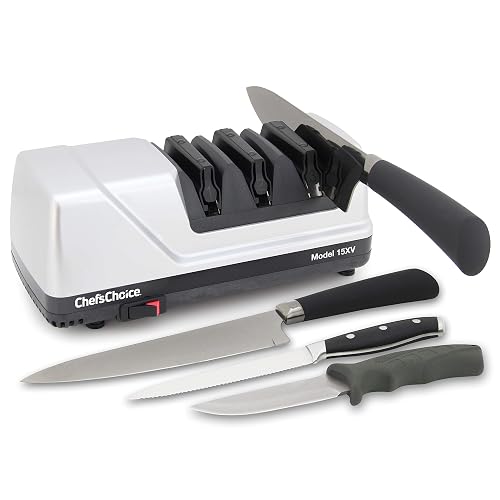 TOP CHOICEBest overallChef'sChoice 15XV EdgeSelect Professional Electric Knife SharpenerView on Amazon
- 2
 TOP CHOICEBest for small kitchensChef'sChoice Manual Knife Sharpeners 2-StageView on Amazon
- 3
 TOP CHOICEBest budget pickComplete Knife Sharpening Stone SetView on Amazon
- 4
 Best for quick touch-upsDiamond Sharpening Steel 12 inchView on Amazon
- 5
 Best for consistent anglesKnife Sharpener Tool Rolling KitView on Amazon
Our Top Picks
Before comparing products, it helps to know what each tool actually does. A chef knife edge is a thin V-shaped bevel, usually between 15 and 20 degrees per side on most Western and many Japanese-style blades. Sharpening removes a small amount of steel to rebuild that bevel, and honing realigns the edge that bends during use. Good tools either hold that angle for you or make it easy to repeat by hand.
Quick Comparison
| Product | Best for | Key feature |
|---|---|---|
| Chef’sChoice 15XV EdgeSelect Professional Electric Knife Sharpener | Regular home cooks who want a fast, consistent edge | Three stages with 100-percent diamond abrasives |
| Chef’sChoice Manual Knife Sharpeners 2-Stage | Small kitchens and simple storage | Compact manual sharpener with 15 and 20 degree angles |
| Complete Knife Sharpening Stone Set | Cooks who want to learn freehand sharpening | Dual-grit whetstone with leather strop and angle guide |
| Diamond Sharpening Steel 12 inch | Maintaining an edge between sharpenings | Long diamond-coated rod for quick realignment |
| Knife Sharpener Tool Rolling Kit | Cooks who want repeatable angles without an electric unit | Rolling diamond and ceramic wheels with 15 and 20 degree magnetic guides |
Chef’sChoice 15XV EdgeSelect Professional Electric Knife Sharpener
Chef’sChoice 15XV EdgeSelect Professional Electric Knife Sharpener with 100-Percent Diamond Abrasives and Precision Angle Guides for Straight Edge and Serrated Knives, 3-Stage, Gray
Best for: Overall edge restoration with minimal technique
This suits home cooks who want a dependable edge without learning a freehand method. It is a good fit for dull knives that need real reshaping, not just a quick polish.
Key specs
- Electric sharpener with three stages
- 100-percent diamond abrasives
- Precision angle guides for straight and serrated edges
Pros
- Produces a consistent angle across the whole blade
- Works on both straight-edge and serrated knives
- Owners often report a sharp edge in a few minutes
Cons
- Removes more steel than a stone, so use it sparingly
- Takes up counter space
Bottom line: A strong first choice for cooks who want reliable results and do not plan to learn freehand sharpening.
Chef’sChoice Manual Knife Sharpeners 2-Stage
Chef'sChoice Manual Knife Sharpeners for 15- and 20-Degree Straight-Edge and Serrated Knives with Diamond Abrasives Precise Angle Control & Compact Footprint, 2-Stage, Gray
Best for: Small kitchens
This manual unit is for cooks with limited space who still want guided angles. It works well for regular maintenance on 15 and 20 degree blades.
Key specs
- Manual sharpener with two stages
- Diamond abrasives
- 15 and 20 degree straight-edge and serrated settings
Pros
- Compact footprint for drawers or small counters
- No power cord needed
- Guided slots make the angle easy to repeat
Cons
- Requires more passes than an electric model for badly dulled blades
- Not ideal for very large chef knives
Bottom line: A practical pick for cooks who want guided sharpening in a small space.
Complete Knife Sharpening Stone Set
Complete Knife Sharpening Stone Set – Dual Grit Whetstone 400/1000 3000/8000 Knife Sharpener with Leather Strop, Flattening Stone, Bamboo Base, 3 Non-slip Rubber Bases & Angle Guide
Best for: Learning freehand sharpening on a budget
This set suits cooks who want to build a skill and control the edge themselves. Expect a learning curve, but a stone gives the most control over the final finish.
Key specs
- Dual-grit whetstone with 400/1000 and 3000/8000 grit options
- Leather strop for polishing
- Flattening stone and angle guide included
Pros
- Wide grit range for coarse repair and fine polishing
- Flattening stone helps keep the surface true
- Bamboo base and rubber feet add stability
Cons
- Requires soaking and regular flattening
- Takes practice to hold a steady angle by hand
Bottom line: The best value for cooks willing to learn, especially those who want a true polished edge.
Diamond Sharpening Steel 12 inch
Diamond Sharpening Steel – 12 inch Knife Sharpener for Master Chef, Ideal for Kitchen Knife, Cooking Knife, Butchers and Japanese Knife, Home Gourmet Blade Sharpening Stick
Best for: Maintaining an edge between sharpenings
A steel is a maintenance tool, not a full sharpener. It is best for cooks who already have a sharp edge and want to keep it aligned between sessions.
Key specs
- 12 inch rod length
- Diamond-coated surface
- Designed for kitchen and Japanese-style knives
Pros
- Quick to use before cooking
- Diamond surface cuts faster than a standard ceramic steel
- Compact enough for a knife block area
Cons
- Cannot repair a badly chipped or dull edge
- Needs correct angle technique to avoid rounding the edge
Bottom line: Pair this with a real sharpener rather than using it alone; it extends time between sharpenings.
Knife Sharpener Tool Rolling Kit
Knife Sharpener Tool, Rolling Knife Sharpener Kit, Knife Sharpening with Diamonds and Ceramic for Steel of Any Hardness, Kitchen knife Sharpener with 15 & 20 Degree Magnetic Angle(Brown)
Best for: Repeatable angles without an electric unit
This rolling kit suits cooks who want guided angles and a simple setup. The magnetic guides help hold 15 and 20 degree bevels steady through each pass.
Key specs
- Rolling diamond and ceramic sharpening wheels
- 15 and 20 degree magnetic angle guides
- Designed for steels of varying hardness
Pros
- Guides make angle consistency easier for beginners
- Handles a range of steel hardness
- Portable and requires no power
Cons
- Rolling wheels take time to master for long blades
- Results depend on careful, even pressure
Bottom line: A good middle option for cooks who want guided control without buying an electric sharpener.
Buying Guide
Sharpening method
Electric sharpeners are fastest and most consistent. Stones give the best control and finish but require practice. Manual guided sharpeners sit between the two. Choose based on how much time and skill you want to invest.
Good picks for this: Chef’sChoice 15XV EdgeSelect Professional Electric Knife Sharpener, Complete Knife Sharpening Stone Set
Angle control
Most Western chef knives sit around 20 degrees per side, while many Japanese-style blades are closer to 15. Guides, slots and rolling wheels help you hold the angle. Without them, freehand sharpening takes a lot of practice to stay consistent.
Good picks for this: Chef’sChoice Manual Knife Sharpeners 2-Stage, Knife Sharpener Tool Rolling Kit
Grit range
Coarse grits (around 200 to 400) repair damage, medium grits (around 1000) refine the bevel, and fine grits (3000 and above) polish the edge. A tool with only one stage may leave the edge rougher than you want for slicing.
Good picks for this: Complete Knife Sharpening Stone Set, Chef’sChoice Manual Knife Sharpeners 2-Stage
Abrasive material
Diamond abrasives cut quickly and stay flat, while ceramic and stone surfaces give a smoother finish. Diamond plates are common in home sharpeners because they resist wear and work on hard steels.
Good picks for this: Chef’sChoice 15XV EdgeSelect Professional Electric Knife Sharpener, Diamond Sharpening Steel 12 inch
Size and storage
Measure your counter or drawer space before buying. Stones need room to soak and dry, while manual sharpeners and steels store easily. Long steels need a wall rack or knife block space.
Good picks for this: Chef’sChoice Manual Knife Sharpeners 2-Stage, Diamond Sharpening Steel 12 inch
Steel hardness compatibility
Harder steels, often found in premium Japanese knives, can be harder to sharpen with soft abrasives. Diamond and ceramic surfaces handle a wider range of hardness than many basic stones.
Good picks for this: Knife Sharpener Tool Rolling Kit, Chef’sChoice 15XV EdgeSelect Professional Electric Knife Sharpener
Maintenance routine
Plan a regular rhythm: hone the edge at home every few uses, and sharpen when cutting feels sluggish or the blade slips on tomatoes. Stones need flattening and soaking; electric sharpeners need occasional cleaning of the slots and dust.
Good picks for this: Diamond Sharpening Steel 12 inch, Complete Knife Sharpening Stone Set
FAQ
What is the best way to sharpen a chef knife for beginners?
A guided sharpener, either electric or manual with angle slots, is the easiest route. It holds the bevel at a set angle so you can focus on passing the blade through evenly.
How often should I sharpen my chef knife?
Many home cooks sharpen every few months and hone with a steel more often. Your schedule depends on how much you cook and what you cut. Sharpen when the knife starts to tear rather than slice.
Is a honing steel the same as sharpening?
No. A steel realigns a bent edge but does not remove enough steel to create a new one. Sharpening reshapes the bevel. Use both for the best long-term results.
What angle should I use for a chef knife?
Many Western chef knives are sharpened at about 20 degrees per side. Many Japanese-style blades use about 15 degrees. Check your knife manufacturer’s guidance if you are unsure.
Can I use a whetstone on any chef knife?
Most stainless and carbon steel chef knives can be sharpened on a whetstone, but the stone needs to be soaked and kept flat. Beginners should practice on an older knife first.
Do electric sharpeners damage knives?
Electric sharpeners remove steel quickly, so they should be used sparingly. Owners often report good results when following the manufacturer’s stage instructions. Avoid repeated passes on delicate or thin blades.
Conclusion
The best way to sharpen a chef knife depends on your skill level and how often you cook. For most home cooks, the Chef’sChoice 15XV EdgeSelect Professional Electric Knife Sharpener offers a dependable, consistent edge. Cooks with limited space may prefer the Chef’sChoice Manual Knife Sharpeners 2-Stage. Those who want to learn freehand sharpening should consider the Complete Knife Sharpening Stone Set. The Diamond Sharpening Steel 12 inch helps maintain an edge between sessions, and the Rolling Knife Sharpener Kit suits cooks who want guided angles without power. Match the tool to your habits and maintenance schedule.
Sources
- Workplace knife and cutting tool safety guidance relevant to handling sharp blades (osha.gov)
- Consumer safety information on kitchen cutlery and sharp edge hazards (cpsc.gov)
- Food safety and kitchen hygiene guidance for preparing fresh produce and meat (usda.gov)
Related reading
- Top 6 Chef Schoice 15xv Electric Knife Sharpener Options Compared (2026)
- Top 6 Chef Knifes for Kitchen Picks for Home Cooks
- Top 3 Chef Leather Knife Roll Picks for Every Kitchen
About Claire Whitaker
Claire Whitaker is part of our editorial team and reviews and edits our cookware & knives guides, checking product details against manufacturer specifications and owner feedback.


