
 By Claire Whitaker
Updated November 2026
The Smith’s Pocket Pal knife sharpener is a small, fold-out handheld tool built for people who need to touch up a blade away from a kitchen or workbench. It suits hunters, anglers, campers, and everyday-carry users who want a light sharpener that fits in a pocket or tackle box and handles a quick edge refresh. It is a poor choice for anyone expecting to restore a badly damaged chef’s knife or to sharpen large kitchen blades to a fine, polished edge. Buyers who want a bench-style sharpener, or a tool for regular full-length kitchen knives, should look at larger two-stage or electric models instead.
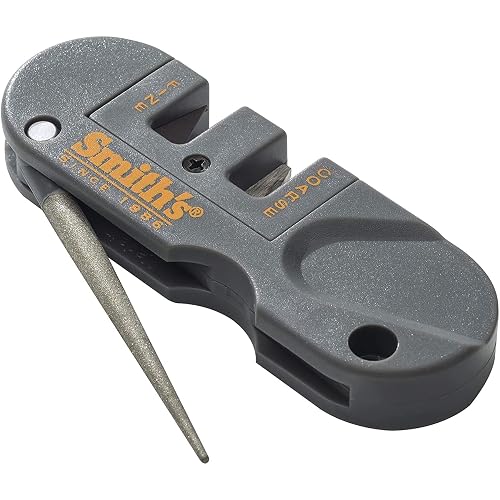
Smith's PP1 Pocket Pal Knife Sharpener Preset Carbide & Ceramic Stone Sharpeners Fold-Out Diamond Coated Rod Outdoor Hunting Knife & Hook Sharpener, Handheld, Compact, Lightweight, Multiuse
Product Overview
The Smith’s PP1 Pocket Pal is a compact, folding sharpener marketed for outdoor and field use. The listing describes it as a preset carbide and ceramic stone sharpener with a fold-out diamond-coated rod, positioned for hunting and fishing knives as well as hooks. Its design centers on portability: it is handheld, lightweight, and meant to be carried in a pocket, belt pouch, or fishing vest without much bulk.
The core idea is simple. Carbide sharpens by abrading the edge quickly, ceramic refines the edge, and the diamond-coated rod handles hard steel and small detail work such as hook points. Because the tool uses fixed, preset angles and slots rather than a free-form stone, the user does not need to hold a precise angle by feel. That makes it easier for a beginner to get a usable edge, though it also limits how much control an experienced sharpener can apply.
It is best understood as a field maintenance tool. Its purpose is to keep an edge working through a day of use, not to rebuild an edge from scratch. Anyone approaching it with that expectation will find it more useful.
Key Features & Specifications
The specifications below reflect what the listing name states and what is commonly associated with this model. Where exact dimensions or weights were not something I could confirm, I have left them out rather than guess.
| Feature | Details |
|---|---|
| Model | Smith’s PP1 Pocket Pal |
| Sharpening elements | Preset carbide and ceramic stones |
| Additional element | Fold-out diamond-coated rod |
| Intended uses | Hunting knives, fishing knives, hooks |
| Format | Handheld, folding, compact |
| Weight | Lightweight (manufacturer describes it as lightweight; exact figure not confirmed here) |
| Power source | None; manual operation |
Two points deserve attention. First, the preset design means you get fixed sharpening angles, which simplifies use but means you cannot easily change the angle for a specific blade geometry. Second, the diamond-coated rod is the element most useful for hooks and for steel that resists the carbide, so it is worth knowing where it sits on the tool before you start.
Pros & Cons
Pros
- Compact and folding, so it carries easily in a pocket, tackle box, or pack.
- No power source required; it works anywhere, including remote locations.
- Preset slots reduce the guesswork about maintaining an angle.
- Combines carbide, ceramic, and diamond surfaces in one tool.
- Diamond rod is suited to hook points and hard steel.
- Simple enough for a beginner to use without training.
Cons
- Not designed for restoring heavily damaged or chipped edges.
- Fixed angles limit flexibility for knives with unusual geometry.
- Coarse carbide can remove more metal than needed on fine kitchen knives.
- Not a practical choice for large chef’s knives or long blades.
- Edge quality will not match a dedicated multi-stage kitchen sharpener.
Performance Analysis
Performance for a tool like this depends on what you ask it to do. Based on its specifications, the carbide element is the aggressive stage. Carbide removes steel quickly, which is useful when a blade has dulled after cutting through bone, scales, or fish skin. The downside is that carbide leaves a coarser scratch pattern, so a blade sharpened only on carbide will feel toothy and may dull faster in fine cutting tasks.
The ceramic element is the refining stage. Ceramic is finer and smooths the burr left by the carbide. Working through the coarse-to-fine sequence is the main way to get a usable edge from this type of sharpener. Skipping the ceramic step often leaves a blade that cuts initially but loses its bite quickly.
Owners of compact preset sharpeners commonly report that results are best on blades with a moderate edge angle and on steel that is not extremely hard. The diamond-coated rod addresses harder steel, and its use on hooks is a frequently cited strength because it allows a quick point touch-up in the field. Reports of consistent results usually come from users who keep the blade moving steadily through each slot and who check for a burr before moving to the next stage.
Limitations appear predictably. A badly nicked blade will need more material removed than a pocket tool can comfortably deliver, and repeated use of the carbide stage will gradually shorten the life of the edge. For a hunter or angler, that trade-off is acceptable because the goal is a working edge, not a mirror finish. For a home cook, it is not the right tool for daily kitchen knives.
Who Should Buy This Product?
This sharpener is a good fit for hunters who need to keep a skinning or utility knife working during a trip, anglers who need to sharpen fillet knives and maintain hook points on the water, campers and hikers who carry a pocket knife, and anyone who wants a no-power backup tool in a kit. It also works for people who want a simple first sharpener for basic pocket knives and who value easy, repeatable slot-based sharpening.
You should skip it if your main goal is sharpening kitchen knives daily, if you own long chef’s or santoku blades, or if you want to refine an edge to a very fine, polished finish. Cooks in that category will get better results from a dedicated two-stage or electric sharpener, and a sharpening stone or guided system will give more control on premium steel.
Buying Guide
Before buying any compact sharpener, decide what you are sharpening. Field knives, pocket knives, and hooks have different needs than kitchen knives, and that difference should drive your choice. Consider the following checklist.
- Blade type. Short field and pocket blades suit preset pocket sharpeners. Long kitchen blades need a longer sharpening surface and better angle control.
- Stages. Look for at least a coarse and a fine stage. A single-stage tool will leave a rough edge.
- Portability. If you carry it daily, a folding design with a closed profile is more practical than a bulky block.
- Angle control. Preset slots help beginners. Experienced users may prefer adjustable guides.
- Abrasive type. Carbide is fast, ceramic is refining, and diamond handles hard steel. A combination offers more range.
Several well-known alternatives are worth comparing. The SMITH’S Pocket Pal Knife Sharpener 2-Pack is a value-oriented option for those who want spare units or who plan to keep one in a vehicle and one in a pack.

SMITH’S Pocket Pal Knife Sharpener, 2-Pack
The Smith’s CCKS 2-Step Knife Sharpener is a compact two-stage preset tool with coarse and fine slots, a practical alternative for fishing, hunting, and fillet knives in a plastic housing.

Smith's CCKS 2-Step Knife Sharpener – Yellow – 2-Step Preset Coarse & Fine Slots – Outdoor Handheld Knife Sharpener – Fishing, Hunting, Fillet, Pocket Knives – Compact Plastic Portable Keychain Tool
For readers who want to see how these compact options fit into a broader selection, the site’s roundup of 5 Best Pocket Knife Sharpener Options for Everyday Carry (2026) covers more models, and Smith's 2-Step Knife Sharpener Review: Features and Performance goes deeper on a related two-stage design.
If you are weighing this tool against a broader set of choices, Sharpener for Pocket Knife: How to Choose and Use One (Step-by-Step) explains the selection criteria in detail, and 7 Best Pocket Pal Knife Sharpener Models for Everyday Carry (2026) compares similar pocket-format sharpeners side by side.
FAQ
Can the Smith’s Pocket Pal sharpen kitchen knives?
It can touch up a small kitchen knife in an emergency, but it is not designed for regular kitchen use. Long blades and fine chef’s knives are better served by a dedicated kitchen sharpener with a longer sharpening surface and more controlled angles.
Do I need to use both the carbide and ceramic stages?
Yes, in most cases. The carbide stage removes metal and forms a burr quickly, while the ceramic stage refines the edge. Skipping the ceramic step usually leaves a rough edge that dulls faster.
Is it suitable for hooks?
The diamond-coated rod makes it practical for touching up hook points in the field. For regular hook maintenance, a light pass after each use is usually enough.
How do I know when the edge is sharp enough?
Check for a small burr along the opposite side of the blade after the coarse stage. Once the burr is raised and then removed by the fine stage, the edge should slice paper cleanly and grab a thin material such as cardboard without tearing.
Does it need any special care?
Keep the stones clean and free of metal debris. Rinse the sharpening surfaces after use if they have been in water or contaminated with fish or blood, then let them dry before folding the tool closed. Store it dry to prevent corrosion on the metal parts.
Is it better than a sharpening stone?
It depends on your priorities. A stone offers more control and a finer finish but requires technique and time. The Pocket Pal is faster and more forgiving for a beginner, which suits its field-use purpose.
Is it safe to use on serrated knives?
Serrated edges are generally not suited to flat preset sharpening stones. A dedicated serrated-edge tool or a professional service is a better option for those blades.
Before you buy: helpful guides
About Claire Whitaker
Claire Whitaker is part of our editorial team and reviews and edits our cookware & knives guides, checking product details against manufacturer specifications and owner feedback.



