
 By Claire Whitaker
Updated November 2026
Japanese kitchen knives are usually ground at a shallower edge angle than Western knives, so a japanese kitchen knife sharpener needs to hold that angle consistently or the edge will chip. This list focuses on angle control, grit range, stability on the counter, and how easy each tool is for a beginner to use. Each pick is evaluated from product listings, brand reputation, and common owner feedback patterns.
Our top picks at a glance
- 1
 TOP CHOICEBest overallZwilling 4 Stage Ultra-Sharp Knife Sharpener & Scissor SharpenerView on Amazon
- 2
 TOP CHOICEBest for beginnersSharp Pebble Wet Stone Sharpener & Honing KitView on Amazon
- 3
 TOP CHOICEBest for precise angle controlCangshan 1026108 3-Stage Adjustable Knife + Scissor SharpenerView on Amazon
- 4
 Best for regular honingHOSHANHO Japanese High Carbon Knife Sharpening SteelView on Amazon
- 5
 Best for multi-tool kits4-in-1 Kitchen Knife Accessories: 3-Stage Knife SharpenerView on Amazon
- 6
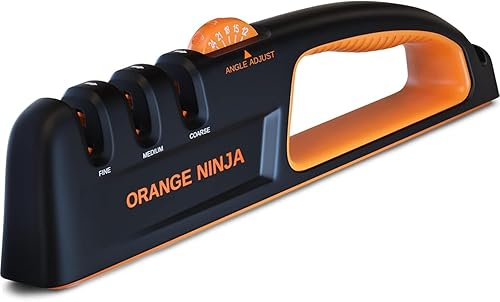 Best for adjustable countertop useManual Knife Sharpening with Adjustable Angles by Sharp Pebble – RepaiView on Amazon
- 7
 Best for scissors and bladesAdjustable Angle for Knife Types, Dull Edge Repair and Fine Honing, ScView on Amazon
Our Top Picks
| Product | Best for | Key feature |
|---|---|---|
| Zwilling 4 Stage Ultra-Sharp Knife Sharpener | Overall use | Four stages, no-slip base |
| Sharp Pebble Wet Stone Sharpener & Honing Kit | Beginners | Guided instructions, 1000/6000 grit |
| Cangshan 3-Stage Adjustable Knife Sharpener | Precise angle control | 14–24 degree adjustment |
| HOSHANHO Japanese Knife Sharpening Steel | Regular honing | Pakkawood ergonomic handle |
| 4-in-1 Kitchen Knife Accessories Sharpener | Multi-tool kits | Includes cut-resistant glove |
| Sharp Pebble Precision Adjust Knife Sharpener | Adjustable countertop use | Adjustable angles, 3 stages |
| MITSUMOTO SAKARI Adjustable Kitchen Knife Sharpener | Scissors and blades | Dedicated scissors slot |
Zwilling 4 Stage Ultra-Sharp Knife Sharpener & Scissor Sharpener
ZWILLINGRestores Ultra-Sharp Blades in Seconds. For Western & Asian Style Blades. Easy to Use, Safe No Slip Base 4 Stage Ultra-Sharp Knife Sharpener & Scissor Sharpener
Best for: Overall use across Western and Asian blades.
This suits cooks who want one countertop tool that handles coarse repair through fine polishing without extra setup. Manufacturers describe it as compatible with both Western and Asian style blades.
Pros
- Four stages cover repair through polish
- No-slip base keeps it steady on the counter
Cons
- Pull-through motion can remove more metal than a whetstone
Sharp Pebble Wet Stone Sharpener & Honing Kit
Angle Guide for Foolproof Results – Wet Stone Sharpener & Honing Kit with Non-Slip Bamboo Base- Guided Beginner Instructions Sharp Pebble Whetstone Knife Sharpener – 1000/6000 Grit Sharpening Stone
Best for: Beginners learning to sharpen with a whetstone.
This kit fits cooks who want to learn freehand or guided stone sharpening with step-by-step instructions included. The 1000 and 6000 grit pairing covers both sharpening and polishing.
Pros
- Guided instructions included
- Non-slip bamboo base holds the stone steady
Cons
- Requires soaking and practice to get consistent results
Cangshan 1026108 3-Stage Adjustable Knife + Scissor Sharpener
Cangshan 1026108 3-Stage Adjustable 14-24 Degree Professional Knife + Scissor Sharpener Black
Best for: Precise angle control on thinner Japanese-style edges.
This suits cooks who want to set a specific edge angle between 14 and 24 degrees. Owners often mention that the adjustment makes it easier to match a blade’s original grind.
Pros
- Adjustable 14–24 degree range
- Three stages for repair and finishing
Cons
- Setup takes more attention than a fixed-angle tool
HOSHANHO Japanese High Carbon Knife Sharpening Steel
Japanese High Carbon Knife Sharpening Steel with Ergonomic Pakkawood Handle, Ideal for All Chef Knives, Gift for Chefs HOSHANHO Honing Rod, 10 Inch Professional Kitchen Knife Sharpener Rod
Best for: Regular honing between full sharpenings.
This rod is meant for realigning an edge that has rolled, not for removing significant metal. It suits cooks who hone most days and sharpen less often.
Pros
- Pakkawood handle is comfortable to grip
- Ten-inch length suits most chef knives
Cons
- Does not repair chipped or badly dulled edges
4-in-1 Kitchen Knife Accessories: 3-Stage Knife Sharpener
4-in-1 Kitchen Knife Accessories: 3-Stage Knife Sharpener Helps Repair, Restore, Polish Blades and Cut-Resistant Glove (Black)
Best for: Multi-tool kits for a household with several knives.
This kit bundles a sharpener with a cut-resistant glove, which can help during handling and sharpening. It suits households that want a starter set in one purchase.
Pros
- Bundled glove adds handling safety
- Three stages for repair and polish
Cons
- Accessory quality can vary between bundle components
Buying Guide
Angle Control
Japanese knives are typically ground at a shallower edge angle than Western knives, so the sharpener you choose should let you set and hold that angle consistently. Look for adjustable guides or fixed-angle slots that match the blade type you own. Inconsistent angles are the most common cause of chipped edges.
Grit Range and Stages
A coarser stage repairs damaged edges, while a finer stage polishes and refines them. Sharpeners with two or more stages cover both jobs, and a finer final stage gives a smoother, more refined edge. Match the grit range to how dull your knives usually get.
Stability on the Counter
A sharpener that slides around during use can ruin an edge and create safety risks. Non-slip bases, rubber feet, or a bamboo base with grip help keep the tool steady while you work. This matters even more for wet stones, which need a stable, flat surface.
Ease of Use for Beginners
If you are new to sharpening, a guided system with clear angle markings or step-by-step instructions will shorten the learning curve. Pull-through sharpeners are the simplest, while wet stones offer more control but require practice. Choose the method you are willing to stick with regularly.
Versatility Across Blade Types
Some sharpeners handle only chef knives, while others also work on scissors, Western-style blades, or serrated edges. If your kitchen includes a mix of knife styles, a tool with multiple slots or angle settings will save you from buying several products.
FAQ
Can I use a Western-style sharpener on Japanese knives?
Many Western sharpeners use angles that are too steep for Japanese blades, which can dull or chip the edge. A sharpener with adjustable or lower angle settings is a safer choice. Always check the angle range before you buy.
How often should I sharpen my Japanese kitchen knife?
Most home cooks sharpen every few months with regular honing in between. How often you need it depends on how often you cook and what you cut. Honing with a steel between sharpenings helps keep the edge aligned.
Is a wet stone better than a pull-through sharpener?
A wet stone gives you more control over the angle and produces a finer edge, but it takes practice to use well. A pull-through sharpener is faster and easier for beginners. Your choice depends on how much time and skill you want to invest.
Do I need to soak a whetstone before using it?
Many whetstones need to soak in water before use, while some modern versions require only a light rinse. Check the instructions for your specific stone. Keeping the stone wet during sharpening helps the process run smoothly.
Can a honing steel replace a sharpener?
A honing steel realigns the edge but does not remove metal, so it cannot fully sharpen a dull blade. It works best as a maintenance tool between sharpenings. For a truly dull knife, you will still need a sharpener.
Conclusion
Home cooks who want the simplest option with reliable angle guidance should consider a multi-stage pull-through sharpener, while those willing to learn a new skill may prefer a wet stone kit. Anyone who mainly needs maintenance between sharpenings will find a honing rod or steel a useful addition to either choice.
For a mixed collection of kitchen tools that includes scissors, look for a sharpener with a dedicated slot and adjustable angles. Matching the tool to your skill level and blade types will get you the sharpest results with the least frustration.
Related reading
- Knife Sharpener for Kitchen: A Step-by-Step Guide for Home Cooks
- Kitchen Q Knife Sharpener: How to Use One for Sharper Edges
- Japanese Knife Sharpener Angle: A Step-by-Step Guide for Home Cooks
- Is the Knife Sharpener Kitchen IQ Worth Buying? Pros, Cons and Tips
About Claire Whitaker
Claire Whitaker is part of our editorial team and reviews and edits our cookware & knives guides, checking product details against manufacturer specifications and owner feedback.



