Quick answer
Our overall pick for a best knife sharpener is the AIERLIAN Rolling Knife Sharpener for its precise angle control and multi-stage abrasive system. The Chef’sChoice 15XV is a top choice for those who prefer a fast, electric sharpener, while the SHARPAL 191H suits those needing a compact, multi-tool sharpener for knives and scissors.
A sharp knife is a safer, more efficient tool, and finding the best knife sharpener for your kitchen is key to maintaining that edge. With options ranging from manual pull-throughs to electric systems, the right choice depends on the types of knives you own, your desired level of control, and your comfort with the sharpening process. We compared manufacturer listings and specifications to highlight models that offer distinct approaches to achieving a sharp edge.
Our guide focuses on the features and limitations stated in the product data, helping you understand what each sharpener is designed to do. For more on maintaining your tools, see our Kitchen Knife Care Guide.
Our picks at a glance

Pros
- Uses diamond and ceramic abrasives for sharpening and polishing.
- Magnetic wood base holds knife at fixed 15° or 20° angles.
- Includes a leather strop for a final razor finish.
- Gift box packaging.
Cons
- The listing states it is not for serrated knives.
- Manual operation requires more user involvement than electric models.
- Wood base and components may require careful handling.

Pros
- Lists compatibility with straight and serrated knives.
- Reversible tungsten carbide blades.
- Ergonomic handle and finger guard for safety.
- Dishwasher safe for easy cleaning.
Cons
- Uses a single, coarse grit type for sharpening.
- The listing does not mention angle guides for consistency.
- Plastic construction may not feel as durable as other materials.
Pros
- Offers five adjustable sharpening angles.
- Three-stage sharpening system (coarse, medium, fine grits listed).
- Compact, handheld design.
- Lists use for kitchen, pocket, and hunting knives.
Cons
- The listing states it is not for serrated knives or scissors.
- Made of ABS plastic and rubber.
- The listing does not specify the abrasive materials used.

Pros
- Uses a diamond-plated stainless steel disc.
- Fixed 15° and 20° sharpening angles via magnetic support.
- Promotes durable construction with strong magnets.
- Suitable for kitchen, utility, and specialty blades.
Cons
- The listing does not mention a polishing or stropping stage.
- Larger footprint than some other manual sharpeners.
- The listing does not specify compatibility with serrated knives.
Pros
- Three-stage electric system with diamond abrasives.
- Lists compatibility with straight and serrated knives.
- Patented spring guides for angle control.
- Converts edges to a 15-degree angle.
Cons
- Electric operation requires a power outlet.
- Heavier and larger than manual options.
- More complex operation than basic pull-through models.

Pros
- Three-stage system for knives and a dedicated scissor sharpener.
- Enhanced suction base for stability.
- Compact size for easy storage.
- Includes a 3-year manufacturer warranty.
Cons
- Very small size may be less stable on some surfaces.
- Manual operation.
- The listing does not mention adjustable or fixed angle guides.
How we chose
Our picks are based on a comparison of manufacturer-provided features and specifications from Amazon listings as of October 2026. We did not test, use, or review any products hands-on. We focused on comparing key attributes like sharpening method, included abrasives, angle options, compatibility with different knife types, and any stated limitations.
What to look for
- Sharpening Method: Rolling, electric, and manual pull-through sharpeners offer different levels of speed, control, and consistency.
- Abrasive Materials: Look for diamonds, tungsten carbide, or ceramic discs, which are listed for different stages of sharpening and honing.
- Angle Guides: Consistent angles are crucial. Some models offer fixed or adjustable angle supports.
- Knife Compatibility: Check if the listing states compatibility with straight-edge, serrated, or specialty knives.
- Construction & Safety: Consider materials, stability features like suction bases, and any included safety guards.
Best Knife Sharpeners: our picks in detail
1. Best overall knife sharpener: AIERLIAN Rolling Knife Sharpener
The AIERLIAN Rolling Knife Sharpener is a manual system that uses a rolling disc to sharpen blades. It includes a #400 diamond disc for sharpening and a #3000 ceramic disc for polishing, followed by a leather strop for finishing. The sharpener comes with a magnetic support base made of wood that holds the knife at fixed 15- or 20-degree angles.
The listing states it is designed for steel of any hardness and is suitable for most household kitchen knives, but notes it is not for serrated blades. It includes a gift box and a leather strop for refining the edge after sharpening.
Best for: Best for home cooks seeking precise, multi-stage sharpening with consistent angle control.
Pros
- Uses diamond and ceramic abrasives for sharpening and polishing.
- Magnetic wood base holds knife at fixed 15° or 20° angles.
- Includes a leather strop for a final razor finish.
- Gift box packaging.
Cons
- The listing states it is not for serrated knives.
- Manual operation requires more user involvement than electric models.
- Wood base and components may require careful handling.
2. Best for quick, simple sharpening: AccuSharp Knife Sharpener
The AccuSharp Knife Sharpener is a compact, manual pull-through sharpener. It uses diamond-honed tungsten carbide sharpening blades that can be reversed, which the listing states doubles their lifespan. It features an ergonomic handle designed for both right- and left-handed users and includes a full-length guard for finger protection.
The listing claims it can sharpen most blades in around ten seconds and is compatible with chef’s knives, paring knives, serrated knives, filet knives, and cleavers. It is made of ABS plastic and can be cleaned with soap and water or in a dishwasher.
Best for: Best for a fast, one-step sharpening of both straight and serrated knives.
Pros
- Lists compatibility with straight and serrated knives.
- Reversible tungsten carbide blades.
- Ergonomic handle and finger guard for safety.
- Dishwasher safe for easy cleaning.
Cons
- Uses a single, coarse grit type for sharpening.
- The listing does not mention angle guides for consistency.
- Plastic construction may not feel as durable as other materials.
3. Best for adjustable-angle sharpening: SharpPebble 5 Precision Adjust
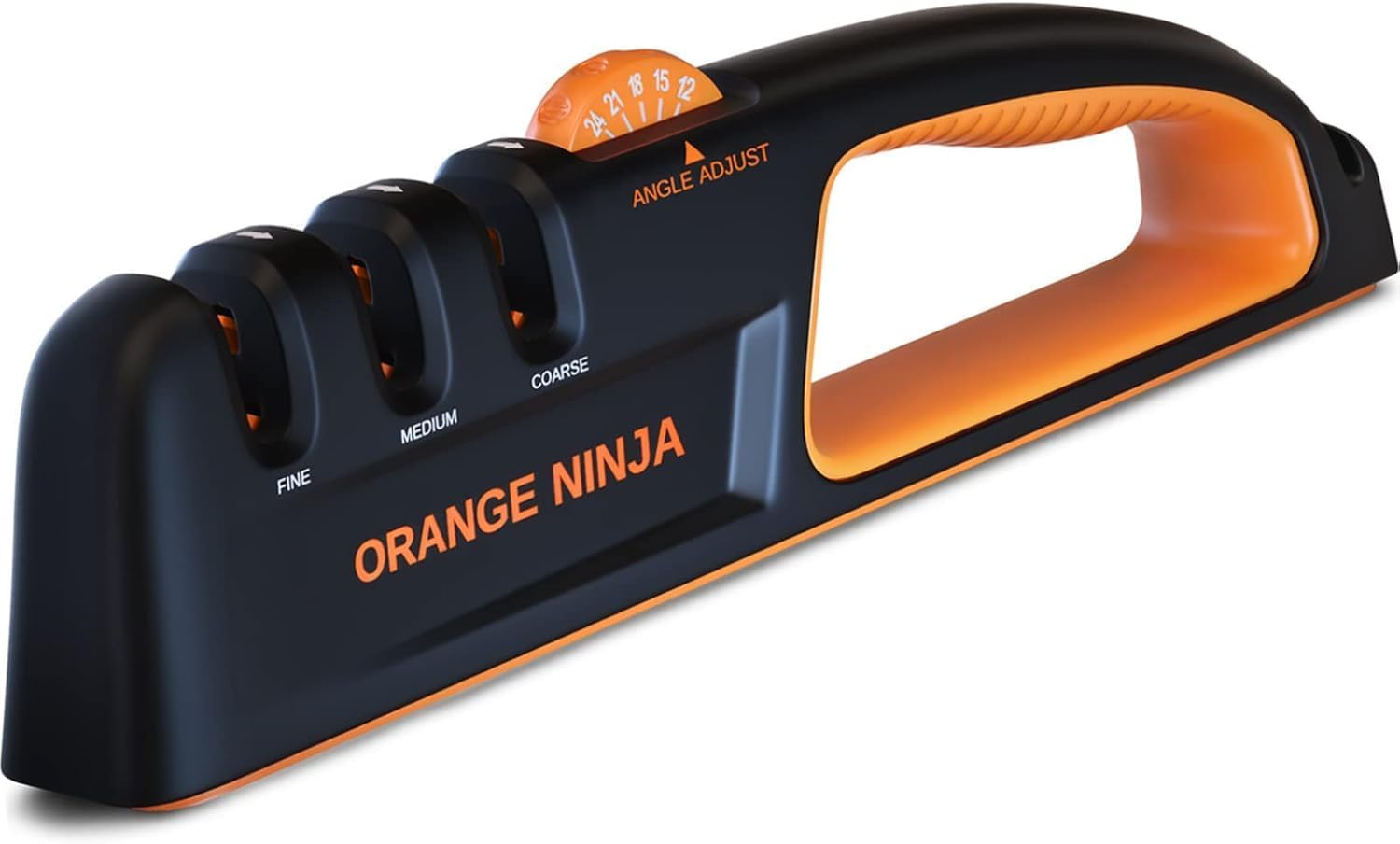
The SharpPebble 5 Precision Adjust is a handheld manual sharpener with five adjustable sharpening angles: 12°, 15°, 18°, 21°, and 24°. It is a three-stage system, though the specific abrasives for each stage are not listed in the provided specs. The sharpener is made from ABS plastic and rubber.
The listing states it is designed for precision sharpening of straight-edge blades only and is not suitable for serrated knives or scissors. It is promoted as a tool for kitchen, pocket, and hunting knives.
Best for: Best for users who want manual control over multiple sharpening angles for straight-edge blades.
Pros
- Offers five adjustable sharpening angles.
- Three-stage sharpening system (coarse, medium, fine grits listed).
- Compact, handheld design.
- Lists use for kitchen, pocket, and hunting knives.
Cons
- The listing states it is not for serrated knives or scissors.
- Made of ABS plastic and rubber.
- The listing does not specify the abrasive materials used.
4. Best rolling sharpener alternative: TUMBLER Rolling Knife Sharpener
The TUMBLER Rolling Knife Sharpener is a manual sharpener that uses a diamond-plated stainless steel disc. It includes a magnetic angle support with fixed 15-degree and 20-degree sharpening angles. The listing states it is designed for kitchen knives, utility knives, and specialty blades.
It is promoted for restoring factory-sharp edges and is built with durable materials and powerful magnets. The product dimensions are listed as 9.53″L x 12.76″W x 3.06″H.
Best for: Best for an alternative rolling sharpener with a focus on durable construction.
Pros
- Uses a diamond-plated stainless steel disc.
- Fixed 15° and 20° sharpening angles via magnetic support.
- Promotes durable construction with strong magnets.
- Suitable for kitchen, utility, and specialty blades.
Cons
- The listing does not mention a polishing or stropping stage.
- Larger footprint than some other manual sharpeners.
- The listing does not specify compatibility with serrated knives.
5. Best electric knife sharpener: Chef’sChoice 15XV Electric Sharpener
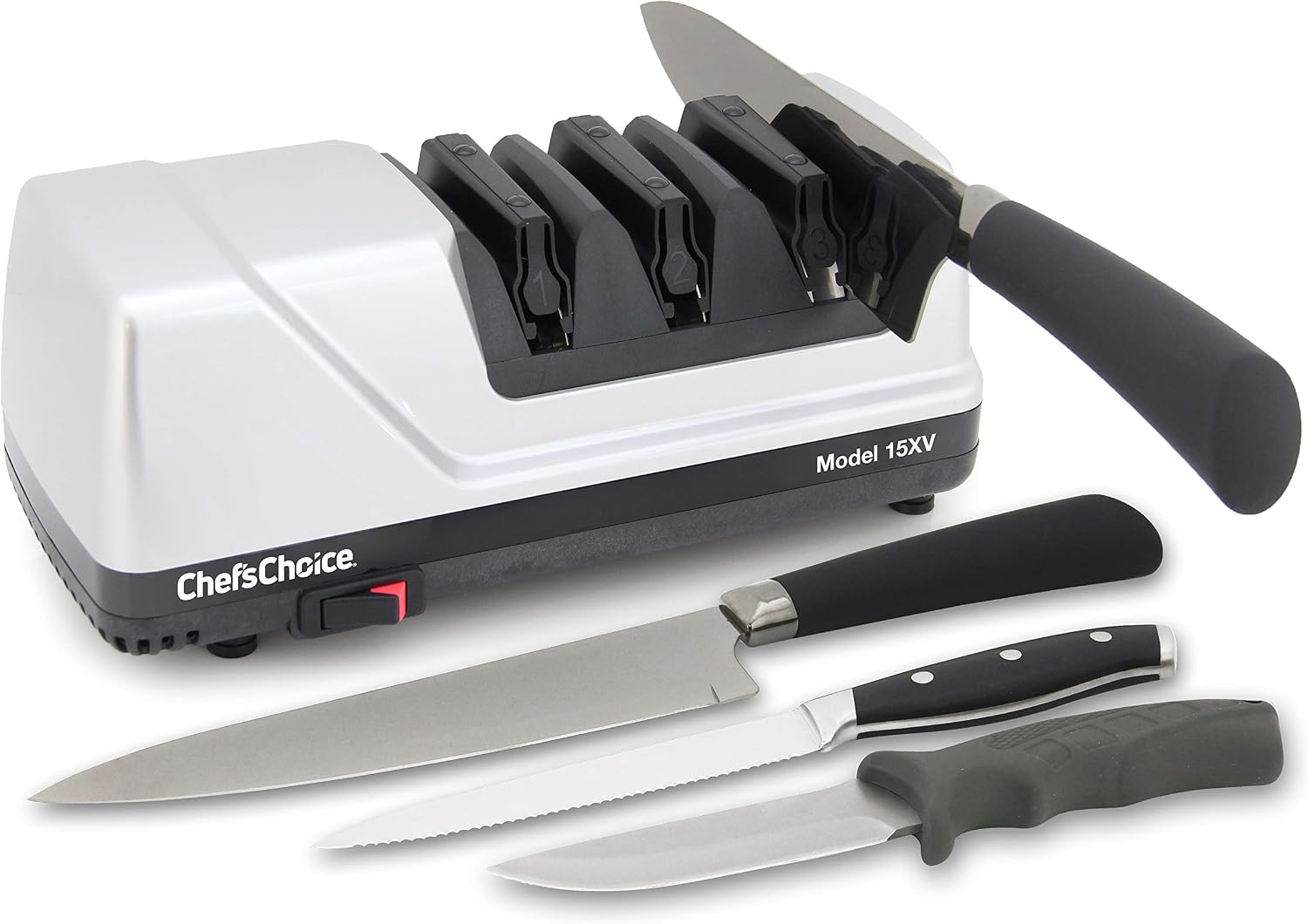
The Chef’sChoice 15XV EdgeSelect is a three-stage electric knife sharpener. It uses 100% diamond abrasives in the first two stages for sharpening and honing; the third stage uses a patented flexible abrasive system to polish and help prolong the life of serrated knives. It features patented flexible spring guides to control the sharpening angle.
The listing states it is designed to convert traditional 20-degree edges into 15-degree Trizor XV edges. It is intended for straight edge and serrated blades.
Best for: Best for fast, electric sharpening of both straight and serrated knives.
Pros
- Three-stage electric system with diamond abrasives.
- Lists compatibility with straight and serrated knives.
- Patented spring guides for angle control.
- Converts edges to a 15-degree angle.
Cons
- Electric operation requires a power outlet.
- Heavier and larger than manual options.
- More complex operation than basic pull-through models.
6. Best compact multi-tool sharpener: SHARPAL 191H 3-Stage Sharpener
The SHARPAL 191H is a compact, three-stage manual sharpener with a suction base. It features tungsten carbide blades for edge setting, ceramic blades for honing, and a specialized tungsten carbide blade for sharpening scissors. The suction base is designed for stability on smooth, flat surfaces.
The listing states it is for straight and serrated kitchen knives and scissors. It comes with a 3-year warranty for non-industrial use.
Best for: Best for a space-saving sharpener that handles knives and scissors.
Pros
- Three-stage system for knives and a dedicated scissor sharpener.
- Enhanced suction base for stability.
- Compact size for easy storage.
- Includes a 3-year manufacturer warranty.
Cons
- Very small size may be less stable on some surfaces.
- Manual operation.
- The listing does not mention adjustable or fixed angle guides.
Knife sharpener picks at a glance
| Sharpener | Type | Key Abrasives | Angle Options | Knife Compatibility |
|---|---|---|---|---|
| AIERLIAN Rolling | Manual Rolling | Diamond, Ceramic | 15°, 20° (Fixed) | Straight-edge (Not for serrated) |
| AccuSharp | Manual Pull-through | Tungsten Carbide | Not listed | Straight & Serrated |
| SharpPebble 5 Precision | Manual Adjustable | Coarse, Medium, Fine (type not listed) | 12°, 15°, 18°, 21°, 24° | Straight-edge only |
| TUMBLER Rolling | Manual Rolling | Diamond | 15°, 20° (Fixed) | Not listed |
| Chef’sChoice 15XV | Electric | 100% Diamond | 15° (via guides) | Straight & Serrated |
| SHARPAL 191H | Manual Multi-tool | Tungsten Carbide, Ceramic | Not listed | Straight, Serrated & Scissors |
How to choose the best knife sharpener
Selecting the right sharpener starts with understanding the methods available. Rolling sharpeners, like our overall pick, offer a unique motion that can provide consistent contact with the blade. Electric models prioritize speed and multi-stage processing with minimal effort, while manual pull-throughs are often the most straightforward and portable. Your choice should align with how much time you want to invest and the level of edge refinement you desire.
Pay close attention to the abrasives listed. Diamond and tungsten carbide are typically used for aggressive metal removal to reshape a dull edge, while ceramic is often for honing and polishing. Some systems include a leather strop for a final, refined finish. Also, check the stated knife compatibility. Many sharpeners work only on straight edges, while others explicitly include serrated blades or even scissors. If you own a variety of knives, a versatile model is key.
Finally, consider the design for safety and consistency. Angle guides—whether magnetic supports, spring systems, or adjustable slots—help maintain the correct edge geometry, which is crucial for a sharp and durable edge. Features like non-slip suction bases or protective finger guards add safety during use. Always follow the manufacturer’s instructions for use and care to ensure safe operation and the best results for your knives. For a deeper dive into techniques, visit our Kitchen Knife Care Guide.
FAQ
What’s the difference between honing and sharpening?
Sharpening is the process of removing metal to create a new edge on a dull blade, often using coarse abrasives like diamond or tungsten carbide. Honing realigns the microscopic teeth on an otherwise sharp edge that have folded over during use, typically using a finer abrasive like ceramic or a steel rod. Many of the sharpeners in our guide combine both processes with multiple stages or abrasives.
Can I use any sharpener on my serrated knives?
No. Many sharpeners, including some in our guide, are specifically listed as not for serrated knives. Others, like the AccuSharp and Chef’sChoice 15XV, list compatibility with serrated blades. Always check the product’s listed compatibility before use, as using the wrong sharpener can damage serrations.
Are electric knife sharpeners safe to use?
Electric sharpeners can be safe when used according to the manufacturer’s instructions. They often include safety features like automatic guides and covered sharpening slots. It is crucial to read the manual, secure the unit on a stable surface, and never force a knife into the sharpener. For general kitchen safety resources, you can refer to the NFPA.
How often should I sharpen my knives?
The frequency depends on how often you use your knives and on what materials. A knife used daily for chopping vegetables may need sharpening every few months, while one used less frequently may go longer. Regular honing with a ceramic rod or the honing stage of a multi-stage sharpener can help maintain the edge between full sharpening sessions. For more on maintenance routines, see our Knife Care Guide.
References
- Amazon product listings and manufacturer specifications (accessed October 2026)
- National Fire Protection Association (NFPA) – Cooking Safety