By Garrett Langley
A cookware set oven safe for your recipes should handle the heat you need without warping, peeling or releasing unwanted residue. This guide shows you how to read a set’s labeling, check the materials and parts that set the temperature limit, and use the pans safely once they are in the oven. By the end, you will know how to confirm a set’s rating in under ten minutes and avoid the mistakes that cause most oven-related damage.
Why Oven Safety Varies Across a Single Cookware Set
Many people assume that if a set is labeled oven safe, every piece can go into the oven at any temperature. That is rarely true. A single set often mixes stainless steel bodies, aluminum cores, silicone or phenolic handles, glass lids and nonstick coatings, and each component has its own ceiling. The lowest-rated part sets the limit for the whole pan.
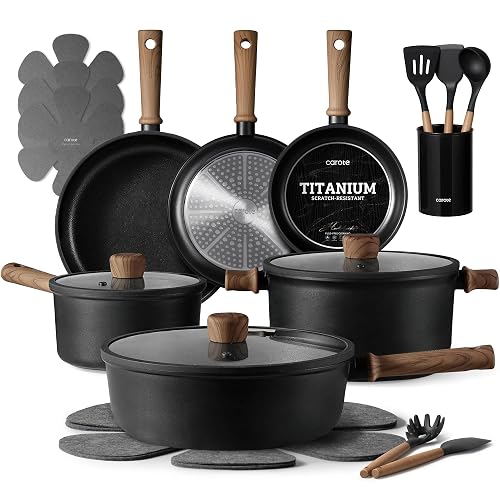
Shopping for one? See our guide: Plateful Titanium Cookware Set Review: Features and Performance.
Manufacturers usually publish a single maximum temperature for the set, but some lines list different numbers for lids, handles and the pan body. When the numbers differ, follow the lowest one.
The Parts That Usually Set the Limit
- Handles: Plastic, silicone or phenolic handles are often rated lower than the metal body. Some are rated only to about 350°F, while stainless or cast iron handles can go much higher.
- Lids: Glass lids commonly have a lower rating than the pan, and knobs made of plastic or Bakelite may not tolerate broiler heat.
- Nonstick coatings: PTFE-based coatings often list a maximum around 400 to 500°F. Ceramic nonstick coatings may have a different limit, so check the packaging.
- Rivets and bonds: In clad construction, the bonding between layers is generally rated high, but the rivets that attach handles can loosen if the pan is repeatedly overheated.
Step 1: Read the Manufacturer’s Oven Rating
Start with the packaging, the box insert or the product page. Look for a phrase such as “oven safe to 500°F” or a line that separates the body from the lid. If the rating is missing, do not assume the set is safe above normal baking temperatures. Contact the manufacturer or use the lower temperature you can confirm.
What to Look for in the Fine Print
- A single maximum temperature for the whole set
- Separate ratings for lids, handles or coatings
- Notes about broiler use, which often carries a stricter limit than baking
- Warnings about microwave use, dishwashers or sudden temperature changes
Step 2: Identify the Materials in Each Piece
Materials tell you how a pan will respond to oven heat. Stainless steel tolerates high temperatures well. Aluminum conducts heat quickly but can warp if it is thin or left empty at high heat. Copper-core and multi-ply clad pans typically handle oven use without trouble. If you want to understand how layered bodies behave, the guide on Understanding Clad and Disc Bottom Cookware Construction explains the construction in more detail.
For a broader look at metal choices, the article on Stainless Steel Cookware Guide covers how steel grades and cladding affect performance. Keep in mind that a steel body does not guarantee that the handle or lid can handle the same heat.
Step 3: Check the Coating and Lid Separately
Nonstick coatings deserve their own check. Most PTFE-based coatings begin to degrade above their rated limit, and overheating an empty nonstick pan can release fumes. The safety basics and how to extend coating life are covered in Nonstick Cookware Safety and Maximizing Lifespan, and Nonstick Cookware Explained describes the different coating types you may encounter.
Lids need the same scrutiny. A glass lid with a plastic knob may be fine at 350°F but unsafe at 450°F. Remove any plastic parts or use a lid-free technique if the rating is not clear.
Coating Temperature Quick Reference
| Component | Typical rating range (check your set) | Notes |
|---|---|---|
| Stainless steel body | Often rated high, commonly 500°F or more | Check handles and rivets separately |
| Cast iron or enameled body | Often rated very high | Enamel may chip if heated empty or cooled quickly |
| PTFE nonstick coating | Often around 400 to 500°F | Degrades above the stated limit |
| Plastic or Bakelite handle | Often rated low, sometimes around 350°F | Frequently the limiting factor |
| Glass lid | Varies widely by manufacturer | Avoid thermal shock and broiler use unless rated |
These ranges are general patterns, not guarantees. Your set’s own instructions always take priority.
Step 4: Confirm Your Oven Temperature
Even a correctly rated set can be damaged if your oven runs hotter than the dial says. Many home ovens vary by 25°F or more. A separate oven thermometer lets you check the real temperature, and Oven Temperature Accuracy explains how to test for drift. Using and Calibrating an Oven Thermometer walks through the calibration process.
Step 5: Use the Pans Safely in the Oven
- Preheat the oven with the rack in place, not the pan.
- Never leave an empty pan in the oven at high heat, especially nonstick.
- Use oven mitts for every handle, since many handles get hot even when the body seems cool.
- Avoid moving a hot pan directly onto a cold or wet surface.
- Let the pan cool gradually before rinsing, to reduce warping and thermal shock.
- Keep lids on or off according to the recipe, and remove plastic lid knobs when the lid goes into a hot oven.
Recommended gear
- Oven thermometer: A standalone dial or digital thermometer lets you confirm the real temperature before you put a set in the oven. View on Amazon
- Silicone oven mitts: Reliable grip and heat resistance matter when handles stay hot after the oven is off. View on Amazon
- Silicone handle sleeves: Sleeves help protect hands when a handle’s rating is lower than the pan body. View on Amazon
Common mistakes
- Assuming the whole set matches the highest number on the box
- Using broiler heat with a set rated only for baking
- Leaving plastic or Bakelite handles uncovered in very hot ovens
- Placing a hot nonstick pan under cold water, which can warp the base
- Storing food in a pan after oven use, which can trap moisture against a coating
Tips
- Keep the manufacturer’s care card with the set so you can check ratings quickly.
- Choose a set with metal handles and lids if you cook often at high oven temperatures.
- When unsure, bake at the lower rated temperature and use an oven thermometer to verify.
- Inspect handle rivets and coatings regularly for looseness or flaking.
FAQ
Can I put a cookware set under the broiler?
Only if the manufacturer says so. Broiler heat is more intense than standard baking, and many handles and lids are not rated for it.
Is “oven safe” the same as “broiler safe”?
No. A pan can be rated for oven baking while still being unsuitable for broiler use. Read both claims separately.
Why does my nonstick pan say 400°F when my oven goes higher?
The coating sets the limit. Keep the oven at or below the stated rating even if the body could tolerate more.
Can I use a glass lid in the oven?
Often yes, up to the rated temperature. Check whether the knob is also heat resistant, since plastic knobs can melt or crack.
What if the labeling is missing?
Contact the manufacturer and ask for the maximum oven temperature for each piece. Until you get an answer, keep baking temperatures moderate.
Does oven use void the warranty?
It can, if you exceed the stated limits. Keep the care instructions and follow them.
Should I consult a professional about cookware safety?
For most home use, the manufacturer’s instructions are enough. If you notice flaking coatings, cracked enamel or loose handles, stop using the piece and ask the manufacturer or a qualified repair service for guidance.
Conclusion
A cookware set oven safe for your cooking depends on its weakest component, not its strongest. Read the manufacturer’s ratings for each piece, check the materials, confirm your oven’s actual temperature, and follow safe handling habits. A few minutes of checking before each bake protects both the set and your food.
Ready to choose one?

About Garrett Langley
Garrett writes about cookware & knives. Each guide starts with research into how products are built and what owners report after months of use, and is revised when better options appear.