By Wyatt Garrett
The chef or santoku knife debate usually comes down to shape and feel. A chef’s knife, with its curved belly and longer blade, suits cooks who rock the blade through herbs, onions and large produce. A santoku, with its flatter edge and shorter, straighter profile, suits cooks who prefer a vertical chopping motion and precise, controlled cuts. Both are excellent all-purpose knives, so the better choice depends on your grip, your cutting habits and the foods you prepare most often.
| Criterion | Chef’s Knife | Santoku Knife |
|---|---|---|
| Blade shape | Curved belly tapering to a pointed tip | Flatter edge with a rounded or sheepsfoot-style tip |
| Typical blade length | Commonly 8 inches, with 6 to 10 inch options | Commonly 5 to 7 inches |
| Primary cutting motion | Rocking and push cuts | Downward chopping and push-pull slicing |
| Best for | Long slicing, rocking through herbs, carving | Dicing vegetables, mincing, precise small cuts |
| Tip usefulness | Strong for scoring, piercing and detail work | Limited; the tip is less useful for fine tasks |
| Knuckle clearance | Curved belly helps with rocking but can hit the board | Flat edge gives generous knuckle clearance on vertical cuts |
| Maneuverability in small spaces | Longer blade needs more room | Compact, easy to control on small boards |
| Sharpening | Standard 15 to 20 degree edges are common | Often ground to a slightly narrower angle, though this varies by maker |
Blade Shape and Cutting Motion: Which Wins?
For most cooks, blade shape decides the choice faster than anything else. The chef’s knife has a pronounced curve from heel to tip. That curve lets you rock the knife forward on the cutting board, keeping the tip in contact while the heel lifts and drops. Cooks who mince parsley or work through a pile of onions often find this motion efficient, because the knife never has to leave the board.
The santoku uses a different geometry. Its edge is mostly flat, so it works best with a straight up-and-down motion. You lift the blade, bring it down, and push forward slightly. Many cooks find this more controlled for thin, even slices of cucumber, potato or cabbage. The santoku also tends to produce neat, uniform dice because each cut is a clean, vertical stroke.
Winner: Chef’s knife for cooks who rock. Winner: Santoku for cooks who prefer vertical chopping. If you have never thought about your motion, watch yourself cut an onion for a minute. Most people already have a preference.
Blade Length and Handling: Which Wins?
Blade length matters for both reach and control. A chef’s knife in the 8-inch range gives you a long cutting edge for slicing roasts, melons, squash and large sheets of produce in one or two strokes. Longer blades are useful for carving, and they handle big jobs without repeated passes.
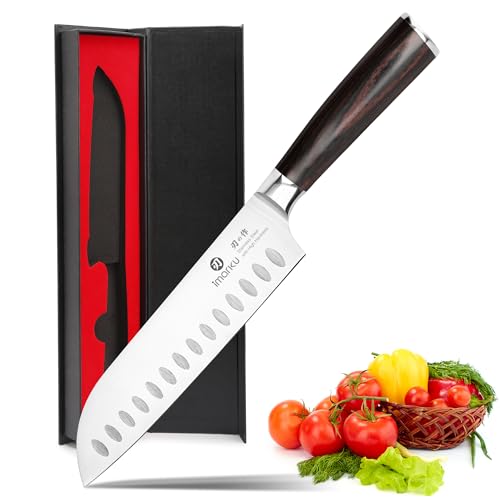
The santoku is shorter, usually 5 to 7 inches. Its compact size makes it easier to manage on a small board, in a crowded prep area or for people with smaller hands. Many home cooks find a shorter knife less tiring for long sessions of repetitive dicing. The trade-off is reach: slicing a long loaf or a large brisket is awkward with a short blade.
Winner: Chef’s knife for reach and big jobs. Winner: Santoku for compact handling and smaller hands. Consider where you cut most often. A narrow counter favors the santoku, while a long board and a lot of large produce favor the chef’s knife.
Tip Design and Fine Work: Which Wins?
The chef’s knife has a more pointed tip. That tip is useful for scoring, piercing, removing cores, trimming silver skin and making precise cuts near the end of the blade. Many cooks use the tip for tasks that a flat-edged knife cannot easily handle.
The santoku usually has a rounded or sheepsfoot-style tip. This design reduces the risk of catching the point on the board, which some cooks find safer for repetitive chopping. The trade-off is that detail work near the tip becomes harder. If your routine includes a lot of trimming or scoring, the santoku’s tip will feel limited.
Winner: Chef’s knife for detail and tip-based work. Winner: Santoku for a blunt, low-risk tip during repetitive chopping. Keep a paring knife nearby for detailed tasks regardless of which you choose. Our guide on Paring Knife Uses: Detailed Guide to Hand-Held Cutting covers those jobs in depth.
Knuckle Clearance and Hand Comfort: Which Wins?
Knuckle clearance is a practical concern. When you chop vertically on a board, your knuckles can strike the cutting surface if the blade’s edge rises too steeply near the heel. The santoku’s flatter edge generally provides more room for your knuckles, which is one reason many cooks with vertical chopping habits prefer it.
The chef’s knife’s curved belly allows the rocking motion, but it can also make knuckle contact more likely if you chop straight down. Many cooks adapt by raising their knuckles, choosing a taller board or adjusting their grip. Neither knife is wrong here. Hand size, grip style and board height all play a role.
Winner: Santoku for vertical chopping and knuckle clearance. Winner: Chef’s knife if you rock and keep your knuckles tucked. Handle design also affects comfort. Our overview of Kitchen Knife Handle Materials: Comfort and Durability explains how grip texture and weight distribution change how a knife feels over time.
Balance and Weight: Which Wins?
Balance is where many cooks notice the biggest difference between two knives that look similar on paper. A chef’s knife usually has more blade mass toward the front, which can help momentum during slicing and rocking. A santoku is generally lighter overall, and its balance point often sits closer to the handle, which many people find nimble.
Balance is also a matter of preference. Some cooks want a front-heavy feel that does the work for them. Others want a light, quick knife they can steer precisely. If you are unsure, hold each knife by the handle with your index finger and thumb pinching the bolster, then see where the blade wants to tip. For a deeper look, read Understanding Knife Balance for Better Control.
Winner: Chef’s knife for momentum-driven slicing. Winner: Santoku for light, nimble control. Weight preferences vary widely, so handle both in person if you can.
Versatility Across Common Tasks: Which Wins?
Both knives handle the core tasks of a home kitchen: chopping vegetables, mincing herbs, slicing proteins and breaking down produce. The difference shows up at the edges. The chef’s knife does better with large items, carving and tip work. The santoku does better with fine dicing and quick vertical cuts.
If you cook a wide range of cuisines, the chef’s knife can feel more like a single tool for almost everything. If your cooking centers on vegetables, stir-fries and tidy knife work, the santoku often feels more purpose-built. For a clear rundown of the standard cuts each knife handles well, see Essential Knife Cuts for Home Cooking: A Visual Guide.
Winner: Chef’s knife for breadth of tasks. Winner: Santoku for focused vegetable work. Neither is limited in a home kitchen, so this criterion rarely decides the choice on its own.
Sharpening and Maintenance: Which Wins?
Both knives benefit from regular honing and occasional sharpening. Manufacturers often specify different edge angles, and these vary by brand and model. Many chef’s knives are ground to a standard edge angle that is easy to match with common sharpeners. Santoku edges are sometimes finer, so sharpening takes a little more care to avoid chipping.
Maintenance is essentially the same for both. Hand-wash, dry immediately and store the blade safely. Use a honing rod between sharpenings to keep the edge straight. For step-by-step guidance, see Kitchen Knife Care Guide: Honing, Sharpening, Cleaning and Storage and How to Sharpen a Kitchen Knife at Home. If you are weighing gear, our roundup of Best Knife Sharpeners compares several approaches.
Winner: Tie. Both are straightforward to maintain. The main difference is that a santoku’s finer edge may need a more gentle sharpening approach.
Which Should You Choose?
- Choose a chef’s knife if you rock the blade, cook a lot of large produce, carve roasts or want one knife for nearly every task.
- Choose a santoku if you prefer vertical chopping, want a compact knife for a small workspace or cook mostly vegetables and herbs.
- Choose a chef’s knife if you need a pointed tip for scoring, trimming or precise detail work.
- Choose a santoku if you have smaller hands, want better knuckle clearance or find long blades tiring.
- Choose a chef’s knife if you want the widest range of uses from a single knife.
- Choose a santoku if you want a lighter, more agile knife for everyday prep.
If you are still undecided, consider starting with a chef’s knife, since it covers the most ground. Then add a santoku later if you find you prefer its feel for vegetable work. For a broader comparison of home-cook needs, read Santoku Knife vs Chef Knife (2026): Which Is Better for Home Cooks? and Chef’s Knife Buying Guide.
Product Options for Each Style
Chef’s knife: Look for a well-known brand with a stable, comfortable handle and a blade length that fits your board. Owners often report that an 8-inch chef’s knife is the most versatile starting size. Consider Victorinox Fibrox Pro 8-inch Chef’s Knife as a widely recognized option in this category. View on Amazon
Santoku knife: Look for a compact blade in the 5 to 7 inch range with a balanced feel and a secure grip. Manufacturers often specify different steel types and edge angles, so check the spec sheet. A well-known option in this category is the Mercer Culinary Millennia 7-inch Santoku. View on Amazon
FAQ
Is a santoku better than a chef’s knife for beginners?
Neither is better for every beginner. A chef’s knife is the more common first purchase because it covers the widest range of tasks. A santoku can be easier for beginners with smaller hands or those who prefer vertical chopping.
Can a santoku do everything a chef’s knife can do?
Most everyday tasks, yes. A santoku handles dicing, slicing and mincing well. It is less suited to long slicing, carving large roasts and detail work near the tip, where a chef’s knife has the advantage.
Which knife is safer for home cooks?
Safety depends more on technique and maintenance than on the knife type. A sharp, well-maintained knife is safer than a dull one. Keep your fingers tucked, use a stable board and store knives properly. For guidance, see Safe Knife Handling, Storage, and Kitchen Transport.
Do I need a santoku if I already have a chef’s knife?
Not necessarily. Many cooks manage well with one good chef’s knife and a paring knife. A santoku becomes worth considering if you find your chef’s knife awkward for vertical chopping or if you want a compact second knife.
Should I sharpen a santoku differently from a chef’s knife?
Often, yes. Edge angles vary by manufacturer, so check the specifications. Some santoku edges are finer and benefit from gentler sharpening. If you are unsure, consult the maker’s instructions or a professional sharpener.
Conclusion
The chef or santoku knife choice comes down to how you cut. A chef’s knife wins for rocking motion, long slicing, tip work and broad versatility. A santoku wins for vertical chopping, knuckle clearance, compact handling and focused vegetable prep. Think about your grip, your board space and the foods you cook most, then handle both knives if you can. Either one, kept sharp and well cared for, will serve as the centerpiece of a capable home kitchen.
Related reading
- Santoku vs Chef’s Knife
- Santoku Knife vs Chef Knife (2026): Which Is Better for Home Cooks?
- Chef’s Knife Buying Guide
- Wicked Edge Knife Sharpener Review: Is It Worth It?

About Wyatt Garrett
Wyatt covers cookware & knives, comparing specs, features and long-term owner feedback to help readers choose with confidence.