Quick answer
Our overall pick is the MASAMOTO VG Japanese Chef Knife for its professional-grade stainless steel and full-tang bolster-covered handle from a long-established brand. Other knives on the list suit cooks looking for specific steel types like powdered SG2 or layered Damascus, traditional wa handles, or particular handle materials.
The Gyuto is the Japanese interpretation of the classic Western chef’s knife, designed as a versatile all-purpose tool for the kitchen. Choosing one involves understanding the steel, the handle, and how the knife is constructed. We’ve compared the manufacturer specifications for 19 different Japanese Gyuto knives to help you navigate the options based on what the listings tell us.
Quick picks
- Overall Pick: MASAMOTO VG 8.3″ Gyuto (see on Amazon)
- Best Powdered Steel: Yoshihiro SG2 8.5″ Gyuto (see on Amazon)
- Best High-Hardness SG2: KAWAHIRO SG2 8.27″ Gyuto (see on Amazon)
- Best Damascus with Wood Saya: Yoshihiro VG10 Damascus 8.25″ Gyuto (see on Amazon)
19 Best Japanese Gyuto Knives compared
| # | Product | Best for | Blade Steel Core | Handle Material | Blade Length |
|---|---|---|---|---|---|
| 1 | MASAMOTO VG 8.3″ Gyuto | Best overall professional Gyuto | Hyper Molybdenum Vanadium stainless | Duracon POM | 8.3 inches |
| 2 | Yoshihiro SG2 8.5″ Gyuto | Best with powdered SG2 steel | SG2 (R-2) Powdered | Ocean Blue Stabilized | 8.5 inches |
| 3 | Yoshihiro VG10 Damascus 8.25″ Gyuto | Best with a magnolia wood saya | VG10 Stainless Steel | Rosewood Triple Ring | 8.25 inches |
| 4 | Yoshihiro VG10 16-Layer Damascus 8.25″ Gyuto | Best with a Western-style handle | VG10 Stainless Steel | Mahogany | 8.25 inches |
| 5 | Kimura 8″ High Carbon Molybdenum Gyuto | Best with a POM resin handle | High Carbon Molybdenum Stainless | POM Resin | 8 inches |
| 6 | MITSUMOTO SAKARI 8″ San-Mai Gyuto | Best with a sandalwood gift box | 9Cr18MoV High Carbon Stainless | Rosewood | 8 inches |
| 7 | KAWAHIRO SG2 8.27″ Gyuto | Best with a stabilized burl wood handle | SG2 Powder Steel | Stabilized Burl Wood | 8.27 inches |
| 8 | kanngou VG10 67-Layer Damascus 8.27″ Gyuto | Best with a rosewood and ebony handle | VG10 Stainless Steel | Ebony & Rosewood | 8.27 inches |
| 9 | KAWAHIRO VG10 67-Layer Damascus 8.27″ Gyuto | Best lightweight Damascus option | VG10 Stainless Steel | Ebony | 8.27 inches |
| 10 | KDNKEEN VG10 67-Layer Damascus 8″ Gyuto | Best with an included leather sheath | VG10 Stainless Steel | Wood (Rosewood & Ebony) | 8 inches |
| 11 | kanngou AUS-10 67-Layer Damascus 8.27″ Gyuto | Best with an AUS-10 steel core | AUS-10 Stainless Steel | Ebony Wood | 8.27 inches |
| 12 | HEZHEN 67-Layer Damascus 8.3″ Gyuto | Best with a figured sycamore handle | 10Cr15CoMoV (VG10-equivalent) | Figured Sycamore Wood | 8.3 inches |
| 13 | Simple Song 8″ Single Bevel Gyuto | Best traditional single-bevel edge | 420HC Stainless Steel | Rosewood | 8 inches |
| 14 | SANMEIHO 9-Layer 10CR15MOV 8″ Gyuto | Best with a G10 and rosewood handle | 10Cr15MoV Steel | G10 & Rosewood | 8 inches |
| 15 | SHAN ZU 9-Layer 10CR15MOV 8″ Gyuto | Best with a durable clad construction | 10Cr15MoV Steel | G10 & Rosewood | 8 inches |
| 16 | kanngou AUS-8 8.27″ Gyuto | Best with a pakkawood handle | AUS-8 Stainless Steel | Pakka Wood | 8.27 inches |
| 17 | kanngou Kurouchi AUS-8 8.27″ Gyuto | Best with a kurouchi black-forged finish | AUS-8 Stainless Steel | Ebony & Red Sandalwood | 8.27 inches |
| 18 | RASSE AUS-8 8″ Hammered Gyuto | Best with a detailed care guide | AUS-8 Stainless Steel | Rosewood | 8 inches |
| 19 | AMSZL VG10 8″ Tsuchime Gyuto | Best with a tsuchime no-stick finish | VG10 Japanese Steel | Ebony | 8 inches |
How we chose
Our selections are based on a comparison of manufacturer listings and specifications on Amazon as of October 2026. We did not test, use, or handle any products. We focused on the details provided: the type of steel, the handle material and construction, the blade length, and any special features like hammered finishes or included storage.
Professional & Established Brands
These knives come from brands with noted histories or professional product lines.
1. Best overall professional Gyuto: MASAMOTO VG 8.3″ Gyuto

Pros
- Full-tang construction with a bolster
- Durable Duracon POM handle
- From a brand with a long history
Cons
- The listing does not mention a sheath or storage box.
This Masamoto Gyuto features the brand’s Hyper Molybdenum Vanadium stainless steel in a professional line. It has a full-tang construction with a stainless steel bolster and a black Duracon POM handle designed for easy gripping. The brand has a history dating back to 1866.
Best for: Cooks seeking a professional-grade, stainless steel Gyuto from an established Japanese brand.
2. Best with powdered SG2 steel: Yoshihiro SG2 8.5″ Gyuto

Pros
- SG2 powdered steel construction
- High HRC of 63-64
- Stabilized handle material
Cons
- The listing does not mention a sheath or storage box.
The Yoshihiro Gyuto uses a hammered SG2 (R-2) powdered stainless steel. It has an HRC of 63-64 and comes with an ocean blue stabilized handle and an alternative ivory bolster. The blade length is listed as 8.5 inches.
Best for: Those interested in a high-hardness powdered steel blade.
3. Best with a magnolia wood saya: Yoshihiro VG10 Damascus 8.25″ Gyuto
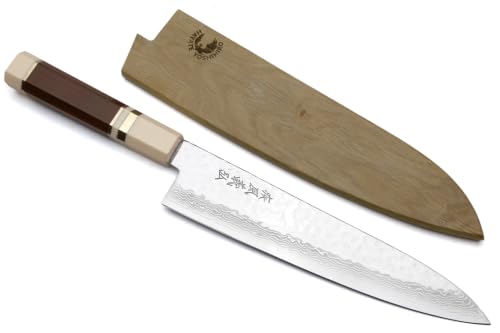
Pros
- 46-layer Damascus with VG10 core
- Includes a magnolia wood saya
- Octagonal rosewood handle
Cons
- Hand wash only (implied by wood handle and saya).
This Yoshihiro knife has a 46-layer hammered Damascus cladding over a VG10 core with an HRC of 60. It features an octagonal rosewood triple ring handle and includes a natural magnolia wood saya cover for storage.
Best for: Cooks who want a Damascus-clad knife with a traditional wood storage sheath.
4. Best with a Western-style handle: Yoshihiro VG10 16-Layer Damascus 8.25″ Gyuto
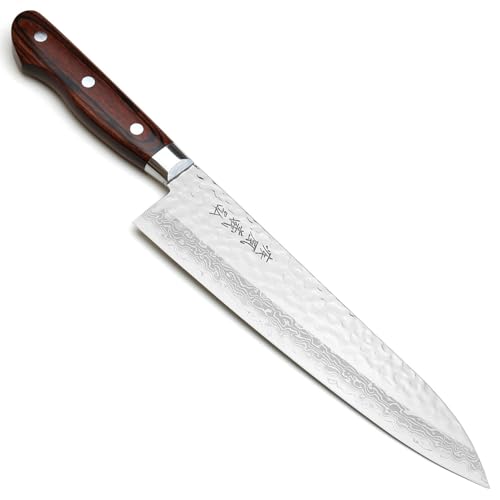
Pros
- 16-layer Damascus with VG10 core
- Ergonomic Western mahogany handle
- Full-tang construction
Cons
- The listing does not include a sheath or cover.
This Gyuto features 16 layers of hammered Damascus steel with a VG10 core (HRC 60). It has a premium Western-style mahogany handle that is ergonomically shaped and extends to the full tang of the knife.
Best for: Those who prefer the feel of a Western-style handle on a Japanese blade.
5. Best with a POM resin handle: Kimura 8″ High Carbon Molybdenum Gyuto

Pros
- Made in Seki, Japan
- Ergonomic POM resin handle
- Full bolster design
Cons
- The listing does not mention a sheath or storage box.
The Kimura Chef Knife is made in Seki, Japan, from High Carbon Chrome Molybdenum Stainless Steel heat treated to 57 HRC. It has a non-slip POM resin handle with a full bolster designed for an ergonomic grip.
Best for: Home cooks looking for a Japanese-made Gyuto with a comfortable synthetic handle.
Modern Hand-Forged & Damascus Styles
Knives featuring layered Damascus steel, hammered textures, and often a kurouchi finish.
6. Best with a sandalwood gift box: MITSUMOTO SAKARI 8″ San-Mai Gyuto

Pros
- 3-layer San-Mai construction
- Includes a sandalwood gift box
- Hand-forged hammered finish
Cons
- Hand wash only (implied by wood handle and finish).
This Gyuto uses a 3-layer San-Mai structure with a 9Cr18MoV high carbon stainless steel core, hardened to about HRC 60±2. It has a hand-forged hammered and kurouchi finish, an octagonal rosewood handle, and comes in a sandalwood box.
Best for: Those seeking a layered San-Mai construction knife presented in a gift box.
7. Best with a stabilized burl wood handle: KAWAHIRO SG2 8.27″ Gyuto

Pros
- SG2 powder steel core (64 HRC)
- Stabilized burl wood handle
- Comes with a wooden gift box
Cons
- Hand wash only (implied by wood handle).
This Gyuto features an SG2 powder steel core hardened to 64 HRC in a 3-layer forged construction. It has a traditional hand-sharpened edge, a full-tang design, and a stabilized burl wood handle. It comes with a wooden gift box.
Best for: Cooks wanting a high-hardness powdered steel knife with a unique stabilized wood handle.
8. Best with a rosewood and ebony handle: kanngou VG10 67-Layer Damascus 8.27″ Gyuto

Pros
- 67-layer Damascus with VG10 core
- Octagonal ebony and rosewood handle
- Includes a premium gift box
Cons
- Hand wash only (implied by wood handle).
This kanngou Gyuto is made from 67 layers of Damascus steel with a VG10 core (HRC 60-62). It is hand-sharpened and features an octagonal handle crafted from ebony and rosewood. It comes with a premium gift box.
Best for: Those looking for a Damascus knife with a distinctive two-tone wood handle.
9. Best lightweight Damascus option: KAWAHIRO VG10 67-Layer Damascus 8.27″ Gyuto

Pros
- 67-layer Damascus with VG10 core
- Lightweight 180g balance
- Includes a wooden gift box
Cons
- Hand wash only (implied by wood handle and kurouchi finish).
This KAWAHIRO Gyuto has a VG10 core with 67 layers of Damascus steel and a distinctive kurouchi forged finish. It is designed to be lightweight (180g) and features a traditional Japanese octagonal ebony wa handle. It comes in a premium wooden gift box.
Best for: Cooks seeking a visually striking, lightweight Damascus Gyuto.
10. Best with an included leather sheath: KDNKEEN VG10 67-Layer Damascus 8″ Gyuto

Pros
- 67-layer Damascus with VG10 core
- Includes a leather sheath
- Full-tang construction
Cons
- Hand wash only (implied by wood handle).
This 8-inch Gyuto features 67 layers of Damascus steel with a VG10 core and a hand-forged finish. It has a full-tang construction with an ergonomic wooden handle and includes a leather sheath for storage.
Best for: Anyone who wants a Damascus Gyuto with protective leather storage.
11. Best with an AUS-10 steel core: kanngou AUS-10 67-Layer Damascus 8.27″ Gyuto

Pros
- 67-layer Damascus with AUS-10 core
- Full-tang ebony handle
- Includes a premium gift box
Cons
- Hand wash only (implied by wood handle).
This kanngou Gyuto is made from 67 layers of Damascus steel with an AUS-10 core (HRC 60-62). It is hand-sharpened and features a full-tang ebony wood handle. It comes with a premium gift box.
Best for: Cooks interested in a Damascus knife with an AUS-10 steel core.
12. Best with a figured sycamore handle: HEZHEN 67-Layer Damascus 8.3″ Gyuto

Pros
- 67-layer Damascus with VG10-equivalent core
- Figured sycamore wood handle
- Vacuum heat-treated
Cons
- Hand wash only (implied by wood handle).
This HEZHEN Gyuto is forged from 67 layers of Damascus steel with a 10Cr15CoMoV core (equivalent to VG10, HRC 60-62). It has a 15-degree edge, an ergonomic handle carved from figured sycamore wood with brass inlay, and undergoes a vacuum heat treatment process.
Best for: Cooks looking for a Damascus knife with a uniquely grained sycamore wood handle.
Ergonomic Handles
Gyutos that highlight specific handle materials or construction for comfort.
13. Best traditional single-bevel edge: Simple Song 8″ Single Bevel Gyuto
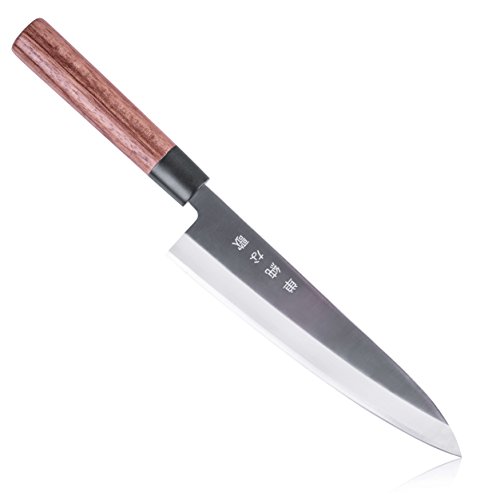
Pros
- Traditional single-bevel edge
- Full-tang rosewood handle
- 420HC stainless steel
Cons
- Single-bevel edges require a specific technique and may not suit all cutting styles.
This Gyuto uses 420HC stainless steel and features a traditional single bevel (chisel) edge ground to a 15-degree angle. It has a full-tang rosewood handle designed for durability.
Best for: Cooks interested in a traditional Japanese single-bevel edge geometry.
14. Best with a G10 and rosewood handle: SANMEIHO 9-Layer 10CR15MOV 8″ Gyuto

Pros
- 9-layer clad construction
- G10 and rosewood hybrid handle
- 62 HRC hardness
Cons
- The listing does not mention a sheath or storage box.
The SANMEIHO Gyuto has a 9-layer clad blade with a 10Cr15MoV steel core hardened to 62 HRC. It features a hand-forged hammered texture and an ergonomic handle made from G10 and rosewood with a decorative brass pin.
Best for: Those who want a hybrid handle with slip-resistant G10 and natural rosewood.
15. Best with a durable clad construction: SHAN ZU 9-Layer 10CR15MOV 8″ Gyuto

Pros
- 9-layer clad steel construction
- 62 HRC hardness
- Ergonomic G10 and rosewood handle
Cons
- The listing does not mention a sheath or storage box.
This SHAN ZU Gyuto is constructed from 9 layers of high-carbon stainless steel with a 10Cr15MoV core rated at 62 HRC. It has a hand-forged hammered texture and an ergonomic handle combining G10 and rosewood with a brass pin.
Best for: Cooks looking for a durable, multi-layer clad knife at this blade length.
16. Best with a pakkawood handle: kanngou AUS-8 8.27″ Gyuto

Pros
- AUS-8 stainless steel
- Pakka wood handle
- Includes a gift box
Cons
- The listing does not mention a sheath.
This kanngou Gyuto uses Japanese alloy steel AUS-8 with a hardness of HRC 59±2. It features a full-tang black pakka wood handle designed for comfort and stability. It comes with a premium gift box.
Best for: Home cooks seeking a reliable, stainless steel Gyuto with a durable pakkawood handle.
17. Best with a kurouchi black-forged finish: kanngou Kurouchi AUS-8 8.27″ Gyuto

Pros
- Traditional kurouchi forged finish
- Ebony and red sandalwood handle
- Includes a gift box
Cons
- Hand wash only (implied by wood handle and finish).
This kanngou Gyuto is made with Japanese alloy steel AUS-8 (HRC 59±2) and features a traditional Kurouchi Tsuchime (black-forged) finish. It has a handle crafted from a blend of ebony and red sandalwood and comes with a premium gift box.
Best for: Those who appreciate the traditional look of a kurouchi finish.
18. Best with a detailed care guide: RASSE AUS-8 8″ Hammered Gyuto
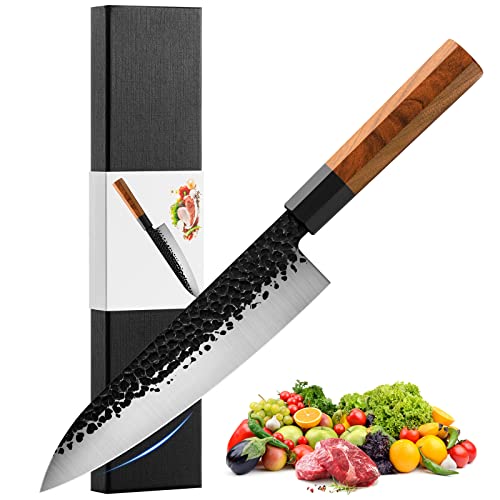
Pros
- Hammered AUS-8 stainless steel
- Ergonomic octagonal rosewood handle
- Listing includes care instructions
Cons
- Hand wash only (as per the listed care instructions).
The RASSE Gyuto has a hammered pattern blade made from high carbon AUS-8 stainless steel with a 15-degree edge. It features an octagonal rosewood handle designed to minimize wrist tension and comes with a gift box. The listing includes specific care instructions.
Best for: Cooks who appreciate clear maintenance guidelines included with their knife.
19. Best with a tsuchime no-stick finish: AMSZL VG10 8″ Tsuchime Gyuto

Pros
- VG10 steel (HRC60-62)
- Tsuchime hammered finish
- Octagonal ebony wa-handle
Cons
- The listing does not mention a sheath or storage box.
This AMSZL Gyuto uses VG10 Japanese steel hardened to HRC60-62 with a 15-degree double bevel edge. It features a hand-hammered tsuchime texture, a full-tang construction, and a traditional octagonal ebony wa-handle.
Best for: Those wanting a VG10 knife with a hammered finish to help prevent food sticking.
How to choose a Japanese Gyuto knife
The Gyuto is your primary all-purpose knife, so its feel and performance are crucial. Your choice will largely depend on the steel, the handle, and the type of construction. The steel type affects edge retention, sharpening ease, and corrosion resistance. Common types in these listings include VG10, AUS-8, AUS-10, SG2 powdered steel, and various high-carbon stainless steels. Powdered steels like SG2 often offer very high hardness for long edge life.
The handle impacts comfort and control. You’ll find Western-style handles, often full-tang with a bolster, and traditional Japanese wa handles, which are usually octagonal. The material—whether it’s wood like rosewood or ebony, stabilized wood, or synthetic like Duracon or POM—affects grip and maintenance. Wood handles typically require hand washing. The knife’s balance point is influenced by whether it’s a full-tang Western design or a wa handle, which can feel more blade-forward.
What to look for
- Steel and Core: Identify the core steel (e.g., VG10, AUS-8, SG2) and its listed hardness (HRC). This indicates potential edge retention and toughness.
- Handle Construction: Decide between a Western full-tang handle for a balanced feel or a wa handle for a more traditional, blade-forward balance. Check the material for durability and care needs.
- Blade Finish & Features: A Damascus cladding or hammered (tsuchime) finish can reduce food sticking. A kurouchi finish is a traditional black forged coating. Also, check if a protective sheath or gift box is included.
FAQ
What is the difference between a Gyuto and a Western chef’s knife?
A Gyuto is the Japanese interpretation of a Western chef’s knife. They are both designed as all-purpose knives, but Gyutos often have a thinner blade profile, a sharper edge angle (often between 12-15 degrees per side), and may use different steel types. They can feature either Western or traditional Japanese handle styles.
Should I choose a Western or a Japanese (wa) handle?
The choice is personal and relates to grip and balance. Western handles are often full-tang, providing a more balanced feel between the blade and handle. Traditional Japanese wa handles, typically octagonal, often create a more blade-forward balance, which some prefer for precise slicing. Consider the material as well, as wood handles require more care than synthetic ones. Learn more in our guide to kitchen knife handle materials.
What does HRC mean, and why does it matter?
HRC stands for Rockwell Hardness Scale. It’s a measure of the steel’s resistance to deformation. A higher HRC number generally indicates the steel can hold a sharper edge for longer, but if it’s too high without proper toughness, the edge can be more brittle. The HRC values listed by manufacturers give you a comparative idea of a blade’s potential performance.
How do I care for a Japanese Gyuto knife?
Always follow the manufacturer’s care instructions. Generally, hand wash and dry your knife immediately after use. Do not put it in the dishwasher, as the heat, moisture, and detergents can damage the blade and handle, especially wooden ones. Store it safely in a knife block, on a magnetic strip, or in a provided sheath. Use appropriate cutting boards (wood or soft plastic) to preserve the edge.
References
- Amazon product listings and manufacturer specifications (accessed October 2026)
- USDA Safe Minimum Internal Temperature Chart
- FoodSafety.gov
- NFPA Cooking Safety